
"I can't tell if the work at our site is subject to special education." "I'm assigning a new foreign worker, but I want to quickly identify which of the 59 categories applies." We receive several inquiries of this kind every month from construction and manufacturing managers. Industrial Safety and Health Regulations Article 36 lists 59 categories — hard to grasp at first glance. This article organizes the 59 categories by group and consolidates the walls and multilingual status when delivering for foreign workers.
Overview of special education
We first anchor the foundation: "what is special education" and "why 59 categories."
Special education is a system based on Industrial Safety and Health Act Article 59 Paragraph 3 (the provision obligating employers to provide special training to workers engaged in hazardous or harmful work). The specific covered work is enumerated in Industrial Safety and Health Regulations Article 36, with additions through revisions resulting in numbers 1 through 59 today.
Who this guide is for: HR and on-site managers at Japan-based employers assigning workers to dangerous or harmful work defined by the Japanese Industrial Safety and Health Act. This article covers Japan's 59 special-education work categories under MHLW Regulation Article 36 — it does not address US OSHA or any other jurisdiction's training requirements.
ⓘ "59 categories" refers to the number of item numbers in Japanese ISHA Regulations Article 36
Because Article 36 lists numbers from 1 to 59, we call them "59 categories." Some items have further subdivisions (i, ii, iii), and the practical work classifications are slightly more. Item numbers are subject to gaps and additions through revisions, so always check the latest Japanese regulation text.
The duty to deliver special education lies with the employer. Tuition, hours, and material costs are all borne by the employer, with delivery during paid working hours as the principle. "The worker took external training at their own expense" departs from the original purpose of safety and health training.
→ Request Labona's safety e-learning materials
Organization by work category
Going through 59 categories one by one is laborious. Grasping the big picture by category first reveals "roughly where your site falls."
The 59 categories in Industrial Safety and Health Regulations Article 36 are not categorically grouped by the regulation itself. In practice, classifying by work nature as follows makes it easier:
- Dust work (grinding wheels, arc welding, oxygen-deficient work, etc.)
- Construction machinery / vehicles (vehicle-mounted construction machinery, rollers, concrete-placing machinery, etc.)
- Crane / slinging (small cranes, derricks, slinging under 1 ton, etc.)
- Forklift / loading (forklifts with max load under 1 ton, shovel loaders)
- Work at heights (full-harness, scaffolding assembly, rope work at heights, etc.)
- Electrical / communications (low-voltage electrical handling, high-voltage and ultra-high-voltage, insulating equipment donning, etc.)
- Industrial robots / machinery (teaching, inspection, machine presses, etc.)
- Special environment (dioxins, tetraethyl lead, Tohoku Earthquake-related decontamination, etc.)
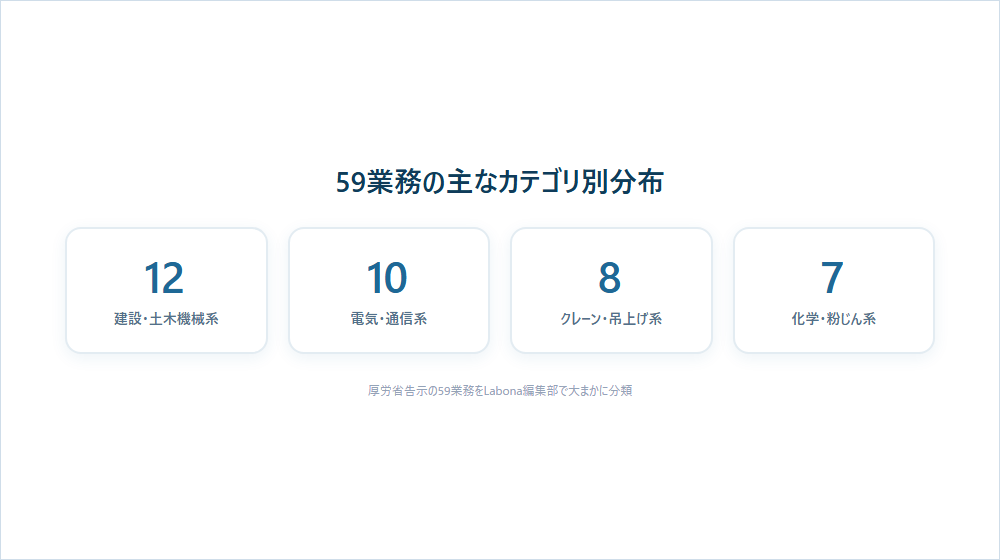
Category boundaries are loose — "arc welding," for example, relates to dust, electrical, and work at heights. When confirming your work, the safe practice is to map item number to work content one-to-one.
Items 1-20: basic work
Items 1-20 cover basic machinery and work appearing in many manufacturing and construction sites. The older the item number, the more "classic" the work — designated since the system's inception.
Representative categories:
- Item 1: Replacement or trial run of grinding wheels
- Item 2: Adjustment / installation of dies and shear blades of power-driven press machines
- Item 3: Welding / cutting metals using arc welders
- Item 4: Installation / inspection etc. of high-voltage (DC over 750V to 7,000V, AC over 600V to 7,000V) or ultra-high-voltage charged circuits or their supports
- Item 5: Operating forklifts with max load under 1 ton (excluding road driving)
- Item 6: Operating shovel loaders or fork loaders with max load under 1 ton
- Item 7: Operating uneven-terrain carriers with max payload under 1 ton (excluding road driving)
- Item 8: Operating cargo lifting equipment with rated load under 5 tons
- Item 9: Operating mechanical lumbering equipment
- Item 10: Felling standing trees, handling hung trees, log-making using chainsaws
Items 11-20 include work related to felling (other than chainsaws), boiler handling, small boiler handling, operating cranes with lifting capacity under 5 tons, operating mobile cranes with lifting capacity under 1 ton, operating derricks, operating construction lifts, slinging on cranes / mobile cranes / derricks with lifting capacity under 1 ton, gondola handling, and work in oxygen-deficient hazardous places.
"Forklift under 1 ton" vs "forklift 1 ton or more" draws the line: the former is special education, the latter is skills training. Confirming the load category is where practical mistakes commonly happen.
Items 21-40: machinery / electrical
Items 21-40 contain many specialized chemical, dust, electrical, and machinery work, tied to specific industries / processes. If your work applies, detailed requirement confirmation per item number is needed.
Representative work:
- Item 21: Handling, maintenance, and repair of special chemical equipment
- Item 22: Taking transmission photographs using X-ray or gamma-ray irradiation devices
- Item 23: Handling nuclear fuel materials etc. in management areas of processing / use facilities
- Item 24: Handling nuclear fuel materials etc. in management areas of nuclear reactor facilities
- Item 25: Dust work (for pneumoconiosis prevention)
- Item 26: Excavation, lining etc. of tunnels
- Item 27: Teaching etc. of industrial robots with manipulators and memory devices
- Item 28: Inspection etc. within the operating envelope of industrial robots
- Item 29: Inflating air into tires using air compressors during automobile (excluding two-wheel) tire assembly
- Item 30: Work where exposure prevention measures for dioxin-containing materials are required
Items 31-40 include decontamination etc. work from the Tohoku Earthquake-related nuclear plant accident, tetraalkyl lead etc. work, dismantling at waste incineration facilities, asbestos handling, scaffolding assembly / dismantling / modification, rope work at heights, dismantling of concrete structures, specified dust work, and work using fall arrest equipment (full-harness type).
Recently added items like full-harness (Item 41) and asbestos-related are short on time since enforcement, and many employers lag in internal record arrangement.
Items 41-59: special work
Items 41-59 are mainly work added to reflect recent occupational accident trends and new technologies. This is also the range where "we thought it didn't apply but actually did" cases tend to arise.
Representative work:
- Item 41: Work using full-harness type fall arrest equipment in places where a work floor cannot be installed at heights of 2 meters or more
- Item 42: Operating boring machines
- Item 43: Adjustment or operation of jack-type lifting machines during construction work
- Item 44: Operating elevated work vehicles with work platform height under 10 meters (excluding road driving)
- Item 45: Adjustment / installation of dies and shear blades of power-driven press machines
- Item 46: Special electrical work associated with cathodic protection (natural potential method) etc.
- Item 47: Dismantling incinerators etc. at waste incineration facilities
- Item 48: Dismantling buildings etc. where asbestos has been used
- Item 49: Decontamination work (Tokyo Electric Power Fukushima Daiichi Nuclear Plant accident)
- Item 50: Work under specified radiation doses
Items 51-59 are mainly new work added through regulation revisions (subdivisions of construction machinery operation / maintenance, subdivisions of felling work, pesticide spraying, high-speed rotation work using abrasives, etc.). Correspondence between item numbers and work content changes with each regulation revision, so internal safety and health rules should be confirmed in the latest version.
Avoiding confusion with skills training
A frequent question from managers employing foreign workers: "What's the difference between skills training and special education?" They are different programs legally, so let's draw a line.
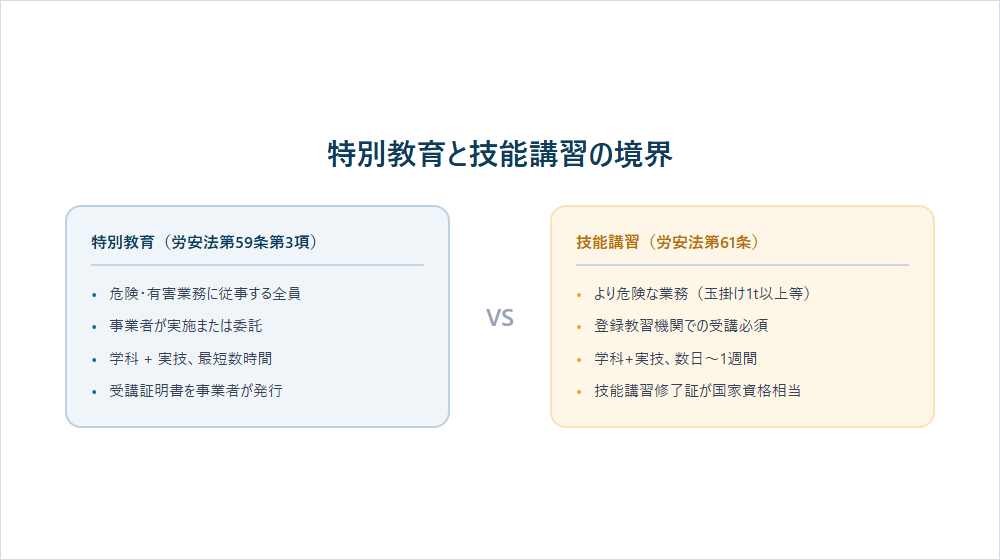
Special education (ISHA Article 59 Paragraph 3) is positioned as in-house training delivered by the employer — most work is several hours combining academic and practical. The employer issues the completion certificate, and no application to an external registered organization is needed.
Skills training (ISHA Article 61) is a public qualification system for occupational-restriction work, requiring attendance at registered training organizations. For example, even for slinging work, on cranes with lifting capacity of 1 ton or more, skills training (completion certificate is equivalent to national qualification) applies; under 1 ton, special education applies — drawn by load.
ⓘ Risk of misdrawing the line
Judging "special education will do" and conducting work covered by skills training exposes the employer to violation of the Industrial Safety and Health Act (imprisonment up to 6 months or fine up to 500,000 yen). The worker also violates occupational restrictions, so confirming the work category before assignment is a mandatory process for managers.
If you're unsure, telling the prefectural labor bureau / labor inspector's safety and health section the work content for confirmation is reliable. Keeping the confirmation result in writing provides audit evidence.
Walls when delivering for foreign workers
From here, we organize the practical walls faced when delivering 59-category special education to foreign workers.
The first wall is identifying applicable work. Even where Japanese workers know "this work needs qualification" from workplace custom, foreign workers don't have that background. Before assignment, the manager must map against the 59-category list and identify the applicable item.
The second wall is availability of multilingual materials. Among the 59 categories, work where foreign workers' share is high — slinging, forklift, full-harness — has commercial e-learning materials available in non-Japanese languages. On the other hand, work with high specialization and limited learner numbers — industrial robot teaching, special chemical equipment handling, asbestos-related — often has effectively no native-language materials.
The third wall is comprehension verification. Just having them take the training doesn't satisfy the duty of care for safety. Native-language simple tests or on-site replication practical (have them actually wear / operate equipment) is needed to objectively back up "they understood."
The fourth wall is record retention. Industrial Safety and Health Regulations Article 38 mandates 3-year retention of training records. For foreign workers, record items tend to grow — including Romaji of name, residence card number, language of training delivery — beyond what Japanese workers' records require.
Labona's coverage
→ Contact Labona (also for details of the materials lineup)
Summary
The 59 categories of Industrial Safety and Health Regulations Article 36 cover classic work like grinding wheels and arc welding through recently added work like full-harness and asbestos-related. The first step is to grasp the rough big picture by category, identify the item number applicable to your site, and confirm the boundary with skills training.
When assigning foreign workers to applicable work, confirm availability of native-language materials and set up post-comprehension verification and 3-year retention as a set. "We had them take it in Japanese so we're legally OK" is a gamble given recent case law trends. Training in a form the worker can understand and its evidence is what separates employer liability at accident.
FAQ
Q1. Where can I officially check the full list of 59 categories?
They are enumerated in numerical order in the text of Industrial Safety and Health Regulations Article 36. Search "労働安全衛生規則" on e-Gov law search and reference Article 36. Because item numbers and work content change with revisions, we recommend checking the original text, not internal document copies.
Q2. Once special education is received, is it valid after job change?
Legally, special education completion records are managed per employer. Bringing the previous employer's completion certificate at job change allows the new employer to judge "trained," but additional training on risks specific to the new employer's site is recommended. Keeping the completion certificate original at both the worker and the previous employer is safer.
Q3. Can 59-category special education be completed entirely with e-learning?
The academic portion can be done via e-learning, but practical is mandatory in most work. For work where practical is defined — full-harness, slinging, forklift, etc. — face-to-face instruction by qualified or sufficiently experienced personnel on site is needed. A hybrid design of e-learning + practical group is realistic.
Q4. Specifically how do we ensure foreign learners' comprehension?
We recommend a 3-set approach. First, video materials with native-language audio. Second, native-language simple test after academic (5-10 questions for comprehension check). Third, replication confirmation in practical (have them actually wear / operate equipment, keep photo records). Test and replication practical results are retained together with learner records for 3 years.
Primary references
- Industrial Safety and Health Act Article 59 Paragraph 3 (Employer's duty for special education) — search "労働安全衛生法" on e-Gov law search
- Industrial Safety and Health Regulations Article 36 (Work requiring special education) — search "労働安全衛生規則" on e-Gov law search
- Industrial Safety and Health Regulations Article 38 (Retention of special education records) — same as above
- MHLW notices on "Special Education Regulations" — search the MHLW website
- MHLW multilingual safety and health training materials for foreign workers — refer to "Labor standards & safety and health" on the MHLW website