
"We delivered the training, but the record is just bound in a paper file." We hear this from mid-sized companies' general affairs officers more and more often. The on-hire training record carries a 3-year retention obligation under Industrial Safety and Health Regulations Article 38, but the distance between "bound somewhere" and "presentable to an inspector on the spot" is large in practice.
This article organizes how to retain on-hire safety and health training records in a way that is both compliant and practical. We cover the limits of paper-based operation, the benefits of digitalization, and additional considerations for employing foreign workers.
Who this guide is for: HR, legal, and on-site managers at Japan-based employers (or Japan operations of multinational companies) employing foreign nationals in Japan. This guide explains Japan's labor law and Japan-specific operational reality — not US OSHA or any other jurisdiction.
The retention obligation under the regulations
Let's first confirm the text and translate "3 years" into its practical meaning.
Article 38 of the Industrial Safety and Health Regulations (the provision requiring employers who deliver special education to retain records for 3 years) directly governs special education records. The retention period for on-hire safety and health training records (Industrial Safety and Health Act Article 59 Paragraph 1) is not explicit in the text, but from administrative guidance and accident-handling practice, the practical mainstream is to set 3 years as the internal standard.
ⓘ What's the starting date of "3 years"?
Counted from the day the training was delivered. A record of training delivered on May 13, 2026 is kept until May 13, 2029. Records of workers who quit mid-period must not be discarded before the 3 years elapse.
Before deciding "the 3 years are up so we can dispose," confirm whether refresher or additional training was needed for that worker. When liability is pursued after an accident, it's the existence of the training record at the time of the accident that matters — companies in doubt are increasingly making 5-year retention the internal rule.
→ Request Labona's safety e-learning materials
The 7 items to record
When someone says "training records," what specifically must be retained for compliance? Here's the practical baseline.
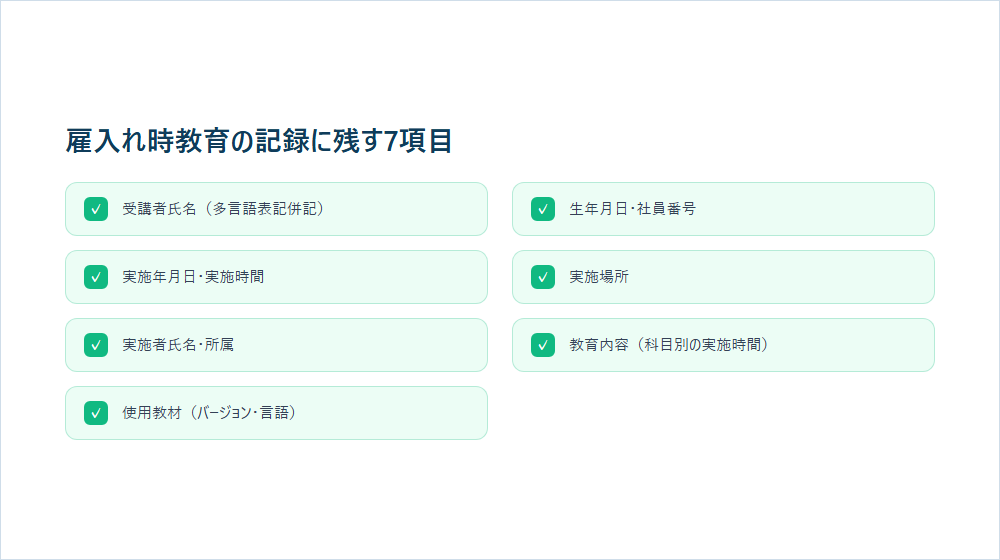
The Industrial Safety and Health Regulations do not enumerate record items in detail, but from past notices and inspector guidance, the standard 7 items are:
- Learner name (include multiple-language spellings where applicable; Romaji is recommended)
- Date of birth, employee number (to handle same-name cases)
- Date and time of delivery (start and end)
- Location of delivery
- Name, affiliation, and contact of the provider
- Training content (per-subject delivery time and key points)
- Materials used (for e-learning, material name, version, language)
In addition, comprehension test results and learner signature (or e-signature) help against case-law risks discussed below.
Accidents arising from paper-based registers
Three real cases of record-handling failures we've seen on site. Map them against your situation.
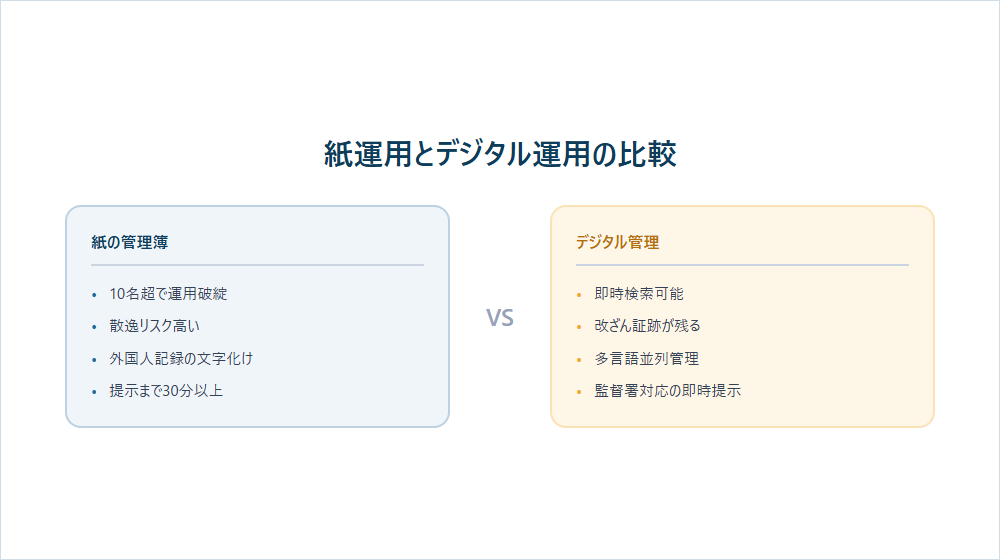
First, dispersion. When the general affairs officer changes hands, "we no longer know where it's filed." Employers who took days to locate records after an accident have been called out by inspectors for "lack of routine management."
Second, alteration risk. Paper files are easy to retroactively edit or swap. In a dispute, the burden falls on the employer to prove "this record was actually created at the time of delivery."
Third, garbled foreign worker records. Handwritten names invite misspellings and consume time identifying the worker. The baseline is to record both passport Romaji and Japanese script side by side, but paper formats vary by site.
⚠️ "It exists" and "we can find it if we search" are different
When an inspector says "show me the record" during a spot check and you spend 30+ minutes searching, that alone signals "inadequate routine management." The practical pass line is "presentable within 3 minutes."
Benefits and caveats of digitalization
For companies considering moving off paper, here are the decision criteria.
Three benefits: searchability (instant lookup by employee number or name), tamper resistance (timestamps and update logs leave a trail), multilingual handling (manage the same information across multiple languages in parallel). Once foreign-worker employment exceeds 10 people, paper-based operation breaks down in practice.
Drawbacks are deployment cost and meeting the equivalent of the "Electronic Records Retention Act" (the law ensuring the trustworthiness of electronically retained documents). Industrial Safety and Health Act does not prohibit electronic retention, but simply dropping a homebrew Excel file in a shared folder makes proving tamper resistance difficult.
What inspectors actually look at during spot checks
As "prep for whenever the inspector arrives," what should you have ready? Organized from interviews with practitioners who've handled inspections.
What inspectors check on on-hire training, roughly:
- Request the list of hires from the past 1–2 years
- Randomly pick several from that list
- Immediate presentation of those workers' training records
- Check the validity of training content (hours, items)
- If needed, interview the learner directly
The "interview" phase asks the worker whether they "remember receiving the training" and "understood the content." If a foreign worker with insufficient Japanese answers "I don't know what this is about," even a formally complete record can be judged as "training that did not substantively take place."
Additional considerations for foreign workers
Employers of foreign workers must go one step further than for Japanese-only records.
First, note the delivery language. The same "we delivered on-hire training" means different things depending on whether the Japanese version or the Vietnamese version was used. Note the language code in the "materials used" field.
Second, save comprehension test results. With Japanese-only classroom training, liability falls back on the employer if the learner did not understand. Native-language test results (score, duration) prove "we confirmed comprehension."
Third, digitalize the learner's signature. Paper signatures sometimes make worker identification hard; using e-learning login history and completion timestamps as evidence of "delivery to the worker themselves" is becoming the practical standard.
Anti-tampering during the retention period
You must maintain a state in which "later alterations" cannot be plausibly alleged during the 3- or 5-year retention.
For paper, number pages sequentially and use double-strikethrough + correction stamps for any edits — physically discouraging wholesale swaps. For digital, use write-protected storage (WORM-type storage or SaaS with tamper detection).
ⓘ The bar for "timestamps are nice to have" has been rising
Through the 2020s, the frequency of timestamp requirements in administrative procedures has increased. While not legally required for training records at this time, "with timestamp" gives a better impression to inspectors — that's the practical reality.
Cases where 5-year retention is needed
Some cases get overlooked if you assume "3 years is enough."
For workers engaged in work subject to special health examinations (medical exams given periodically to workers in specific work like pneumoconiosis, organic solvents, radiation), related training records should be retained long-term — 5 to 30 years depending on the work — alongside the health examination results.
Some companies internally codify "all training records retained 5 years" in their safety management rules. The regulatory minimum is 3 years; given litigation and accident-recognition handling, making 5 years the internal standard is practically easier.
Labona's log management
For reference, what Labona's feature set covers — written honestly within current capabilities.
Labona's e-learning automatically records learner ID, date/time of delivery, material version, language used, comprehension test scores, and completion timestamp. These are CSV-exportable from the admin dashboard for immediate presentation to inspectors. Retention runs through the contract period as a default; extended retention after contract end is supported as an option. Multilingual support: Japanese version is being published progressively, with full-audio English, Vietnamese, Chinese, and Indonesian being expanded.
For companies considering dual operation alongside paper registers, we propose a migration plan that runs both in parallel for the first 3 months and gradually consolidates onto digital.
→ Contact Labona (record management demo also)
Summary
Key points for on-hire training record management:
3-year retention is standard; 5 years for safety margin; special work requires long-term retention. Record 7 items; for foreign-worker employment, "delivery language" and "comprehension test results" matter most. Paper-based operation breaks down past 10 people — digital migration is a practical option. Anti-tampering is handled with sequential numbering + correction stamps on paper, and with timestamps or tamper-detecting SaaS for digital.
Inspector spot checks look at "can it be presented instantly" and "did training substantively take place." Formal records alone are no longer enough.
FAQ
Q1. Do we need to retain records for former employees for 3 years too?
Yes. The Industrial Safety and Health Regulations do not allow shortening the retention period because of resignation. Accident-recognition matters during the in-service period can still be disputed within 3 years post-resignation, so the safe operation is to record the "date of resignation" and continue retention.
Q2. Can we scan paper records, digitize them, and discard the originals?
In principle yes, but you must ensure the digitized record's tamper-evidence. Apply a timestamp immediately after scanning, or retain in storage with tamper detection. The legal issues are complex; consult a labor and social security attorney or a lawyer.
Q3. Is a single batch attendee list acceptable instead of per-person individual records?
For classroom training where date and content are identical, attendee-list format is practically tolerated. But when an inspector interviews "did this particular worker attend," an attendee list alone is hard to corroborate — adding individual signature fields is safer.
Q4. When multilingual materials are used, in what language should the record be kept?
The employer's management record can be in Japanese. However, note the language code in the "materials used" field (e.g., "Video material V2.3 / Vietnamese version"). Providing the worker a copy in their native language is also recommended.
Primary references
- Industrial Safety and Health Act Article 59 Paragraph 1 (On-hire training) — search "労働安全衛生法" on e-Gov law search
- Industrial Safety and Health Regulations Article 38 (Retention of special education records) — search "労働安全衛生規則" on e-Gov law search
- MHLW notices on "Promotion of safety and health training" — search the MHLW website