
"The supervising organization runs safety training in post-arrival sessions, so we've kept on-hire training brief" — words we've heard several times in the past six months from safety officers at manufacturers who accept technical interns. But since 2024, data showing technical interns' accident rates exceeding Japanese workers' has surfaced in multiple places, and MHLW has begun issuing notices that "formal delivery is not enough." With Ikuseishu starting April 2027, the receiving employer's responsibility grows heavier.
This article organizes safety training for technical interns along three axes: "the current program's framework," "common misconceptions among receiving employers," and "preparation for the Ikuseishu transition." We frame it so what to revise before 2027 can be reverse-engineered.
→ Request Labona's safety e-learning materials
Who this guide is for: HR, legal, and on-site managers at Japan-based employers (or Japan operations of multinational companies) employing foreign nationals in Japan. This guide explains Japan's labor law and Japan-specific operational reality — not US OSHA or any other jurisdiction.
The current framework of the Technical Intern Program (until March 2027)
This section overviews who is obligated to do what under the Technical Intern Act and the Industrial Safety and Health Act (ISHA).
The Technical Intern Program is regulated under two pillars: the Act on Proper Technical Intern Training and Protection of Technical Interns (Technical Intern Act) and the Industrial Safety and Health Act (ISHA). The Technical Intern Act defines program operation, authorization of supervising organizations, and OTIT (Organization for Technical Intern Training) authority; ISHA defines the minimum standards for safety and health training under the employment contract. Because technical interns are workers, ISHA Article 59's on-hire training and special education duties are exactly the same as for Japanese workers.
A frequently overlooked point: technical interns have a dual status — "Technical Intern as residency status" and "worker under the employment contract." Responsibility for the former leans on the supervising organization and OTIT; responsibility for the latter leans on the receiving employer. The final responsibility for safety and health lies with the receiving employer — this principle doesn't change under the Ikuseishu program discussed below.
ⓘ Key points
- Technical Intern Act regulates "program operation"; ISHA regulates "safety under the employment contract"
- Technical interns are subject to ISHA Article 59 just like Japanese workers
- Final responsibility for safety and health lies with the receiving employer
Training imposed on technical interns (pre-arrival / post-arrival / receiving employer)
This section organizes the content and responsible parties for the 3 layers of training technical interns take.
Training for technical interns splits into 3 stages on the timeline. First, pre-arrival training, where the sending organization (agent on the home country side) teaches Japanese, lifestyle, basic labor knowledge, and basic safety and health concepts. The Technical Intern Act sets a minimum of 160+ hours as a principle; safety and health is built into part of the classroom content.
Second, post-arrival training. For roughly 1–2 months after arrival in Japan and before assignment, the supervising organization conducts it under its responsibility. Japanese, knowledge of legal protections (Labor Standards Act, ISHA, Minimum Wage Act, etc.), general rules of safety and health, and life rules are the main content; multilingual (native language) delivery is the principle. At this stage, site-specific risks cannot be addressed, so it stays at generalities like machine names, basic protective equipment, and emergency contact methods.
Third, training by the receiving employer. The core is on-hire training right after assignment (ISHA Article 59 Paragraph 1), special education for hazardous work assignment (Paragraph 3, Regulations Article 36), and foreman training (Article 60). What "can only be taught at that workplace" — site-specific risks, training on actual equipment, how to participate in KY (hazard prediction) activities — falls to the receiving employer.
ⓘ The principle running through 3 layers
- Generalities go to the supervising organization (multilingual classroom)
- Site-specifics go to the receiving employer (real equipment, OJT)
- Only when both pass the baton in role does it complete
Three common misconceptions among receiving employers
This section addresses three typical misconceptions we repeatedly encounter on site.
Misconception 1: Post-arrival training completes safety education. The most common. Post-arrival training is general; it doesn't address risks of specific machinery, chemicals, or work at height. Skipping the receiving employer's on-hire training violates ISHA Article 59 (penalty: imprisonment up to 6 months or fine up to 500,000 yen, Article 119).
Misconception 2: It's fine if they pick it up by watching, even without Japanese. What OJT builds is work procedures, not understanding "why it's dangerous." Training in the native language or plain Japanese is not a formal obligation but a substantive requirement to actually reduce accidents. ISHA Article 59 also requires "train when the worker's work content changes," and training that passed by without native-language support carries the risk of being judged "not functioning as training" later in an accident.
Misconception 3: Leave it to the supervising organization and audits are fine. OTIT site checks verify not just the post-arrival training delivery record but also the receiving employer's on-hire training records, special education certificates, and language of materials. Having formal documents but an empty reality is subject to improvement guidance.
Role split with the supervising organization
This section visualizes the boundary between post-arrival training and on-hire training.
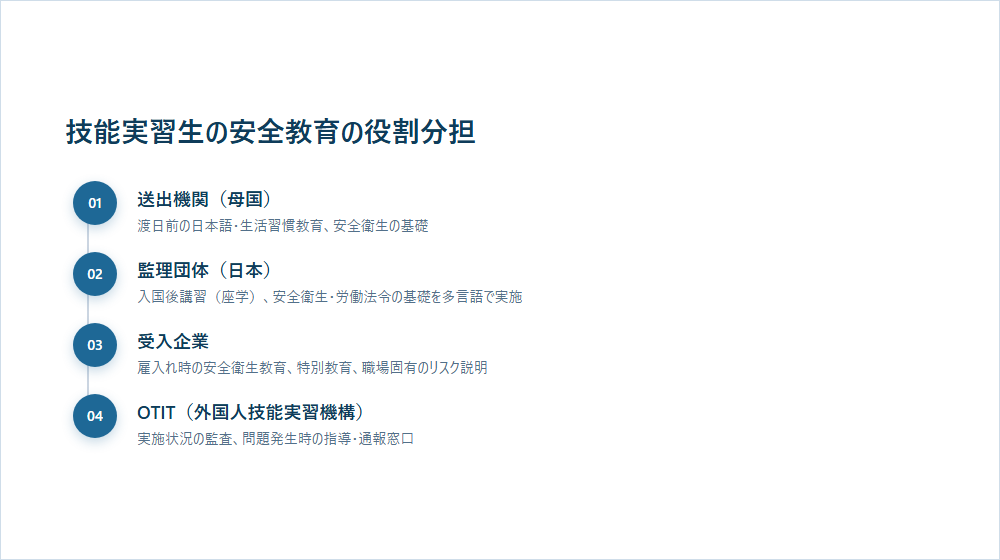
Sorting the role split, you can see 4 actors move in concert. The sending organization lays the groundwork before arrival; the supervising organization runs general training after arrival; the receiving employer runs actual workplace-specific training; OTIT does audit and complaint intake. Without understanding each one's coverage and just assuming "the supervising organization is doing it," gaps open in the parts the receiving employer should handle.
What trips up in practice is "the supervising organization's materials" and "your own materials" not lining up. The supervising organization's standard text has high coverage but isn't tied to the actual equipment, chemicals, or movement lines on site. Your post-assignment on-hire training works best when you receive in writing what the supervising organization taught, and design your training to begin "from there onward" — this reduces overlap and gaps at once.
ⓘ 3 checks for the role split
- Did you receive the post-arrival training completion record in writing?
- Are the lists of machinery and PPE covered in the materials shared?
- Does your on-hire training pick up "from where" the supervising organization's training left off?
Responsibility structure when an accident occurs
This section organizes who is questioned under what law when an accident occurs.
When a technical intern is injured in a work accident, responsibility is questioned in multiple layers. Primarily, the employer (receiving employer) — workers' accident compensation, breach of the duty of care for safety under ISHA, and depending on circumstances, occupational negligence causing death or injury. Second, the supervising organization — whether post-arrival training and patrol guidance functioned, questioned under the Technical Intern Act. Third, OTIT can intervene, potentially issuing improvement orders or revoking authorization.
What to note is responsibility for retention of training records. For on-hire training and special education records, while ISHA Regulations have no explicit duration obligation, 3-year retention is the standard in administrative guidance practice, and 5–10 years is desired as evidence at the time of an accident. Since technical interns have residency periods up to 5 years, the realistic operation is to retain training records from assignment through after they leave.
At the time of an accident, what's first requested is "proof that training was delivered." Date of delivery, target, instructor, materials, presence of native-language support, comprehension verification method — records lacking these 5 points can be judged "weak as proof of delivery" even if documents exist.
Preparation for transition to Ikuseishu (April 2027)
This section shows how safety training's responsibility structure changes under Ikuseishu and what to prepare from now.
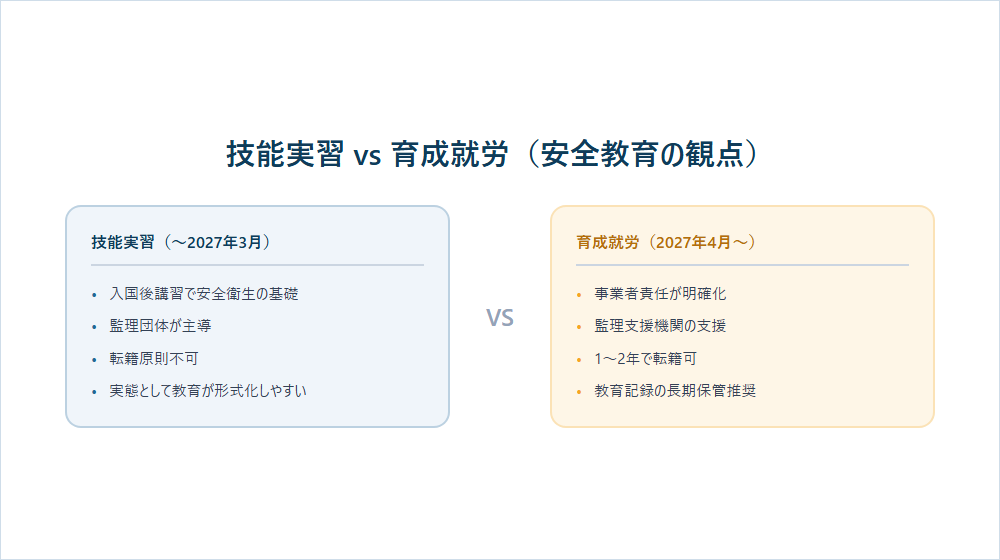
The Ikuseishu program is a new program starting April 2027 to replace Technical Intern. It explicitly states "workforce acquisition" and "workforce development" as purposes, designed to bridge to Specified Skilled Worker (i). For safety training at receiving employers, four main impacts:
First, clarification of employer responsibility. The "international contribution" framing is removed, and the character of "worker under the employment contract" comes to the fore. ISHA duties don't change, but expectations of "the employer's knowledge and care" in administrative guidance and litigation rise. Second, transition to supervising-support organizations. What's called supervising organization in Technical Intern is reorganized as "supervising-support organization" with renamed requirements, strengthening the aspect of supporting the receiving employer. Third, transfer is possible after 1–2 years, necessitating handover and re-training operations at transfer. Fourth, long-term retention of training records. Considering residency duration and transfers, 5–10 year retention becomes the de facto standard.
What to prepare from now: (1) develop multilingual on-hire training materials, (2) digitize training records and retain long-term, (3) procedures to verify prior completion history when accepting transfers, (4) clarify role split with supervising-support organizations at the contract stage.
Transitional measures and notes during the transition
This section organizes practical notes on the "coexistence" that arises in the workplace after April 2027.
The core of transitional measures: those who are residing as technical interns as of April 2027 are treated as technical interns until end of residency. Not everyone switches to Ikuseishu when it starts. As a result, for 2–3 years after April 2027, technical interns and Ikuseishu workers will coexist at the same workplace.
Three operational risks. First, dual management of materials and record formats. Forms for technical interns and forms for Ikuseishu workers coexist, and mix-ups on site become easier. Second, explaining the difference in training content. Even for the same machinery and same work, record items and formats differ slightly per program, so unless instructors are aware of "which program this training is for," record alignment breaks. Third, handover at transfer intake. Since Ikuseishu assumes transfers, you need criteria for how to trust transferring workers' completion history and what to re-train.
ⓘ Tips for designing operations in the coexistence period
- Restructure materials and record formats by "work" rather than "program"
- Save completion history as a set: name, date of delivery, materials, comprehension verification
- Have a checklist for transfer intake separate from contracts, as operational rules
Labona's coverage
This section shows how Labona's safety e-learning supports technical interns and Ikuseishu workers.
Labona is a workplace safety e-learning designed for foreign workers, focused on on-hire training and special education on the receiving employer side for technical interns and Ikuseishu workers. The Japanese version is published progressively, with 4 languages (English, Vietnamese, Chinese, Indonesian) being expanded; structured to switch between native language and Japanese while learning.
Learner records remain per learner on the dashboard, with delivery date, learning time, and comprehension test results saved as evidence. We conscious of formats presentable to OTIT site checks and audits after the Ikuseishu transition, assuming migration from paper-based record operation.
However, Labona is not a replacement for post-arrival training (the supervising organization's scope). It is materials supporting receiving-employer-side training after assignment. We design it so it doesn't duplicate the supervising organization's training, assuming handover at assignment.
Summary
Safety training for technical interns is operated as a three-layer structure of "sending organization, supervising organization, receiving employer." Without understanding each one's coverage, gaps open in the receiving employer's responsibility part. The April 2027 transition to Ikuseishu introduces new issues: clarified employer responsibility, transfer-premised operation, and long-term retention of training records. If you prepare multilingual materials, digitize records, and establish transfer handover procedures progressively from now, you can respond to the transition period without panic.
FAQ
Q1. For technical interns who received post-arrival training, can on-hire training be omitted?
No. Post-arrival training is delivered by the supervising organization as generalities; its purpose and responsible party differ from the "on-hire safety and health training" defined by ISHA Article 59 Paragraph 1. If the receiving employer doesn't deliver training tailored to the assigned site's machinery, chemicals, and movement lines, it violates the law and the responsibility at the time of an accident grows heavier. The correct design is to take the supervising organization's training as the "premise" and continue from there in-house.
Q2. How many years should training records be retained?
ISHA Regulations have no explicit retention duration; in practice 3 years is the standard, and for technical interns and Ikuseishu workers, 5–10 years is recommended considering residency length. As evidence at accident and as handover material at transfer, having long-term digital retention in place gives peace of mind.
Q3. If the supervising organization prepared materials, do we need separate in-house materials?
The supervising organization's materials specialize in generalities and don't include site-specific risks (your own machinery, chemicals, work procedures). For in-house on-hire training and special education, you must separately prepare materials tailored to the workplace. Combining materials specialized for receiving-employer-side training, like Labona, with the supervising organization's materials is efficient.
Q4. After April 2027, do technical interns switch to Ikuseishu workers immediately?
No. Under transitional measures, those residing as technical interns as of April 2027 are treated as technical interns until end of residency. At receiving employers' sites, technical interns and Ikuseishu workers will coexist for 2–3 years, so you need to prepare dual management of materials and record formats.
Primary references
- Technical Intern Act (Act on Proper Technical Intern Training and Protection of Technical Interns) — search on e-Gov law search
- Industrial Safety and Health Act Article 59 (Safety and health training) — search on e-Gov law search
- OTIT (Organization for Technical Intern Training) official site — OTIT
- Ikuseishu program-related information (Immigration Services Agency) — Immigration Services Agency