
"People come from a dispatch agency, but we don't know if we run the safety training or if the dispatch side does." From general affairs officers at user companies, we hear this more and more. From the dispatch agency side, we hear "We don't know the site — being told to run all the on-hire training is a problem." This article organizes the on-hire training responsibility split between the dispatch agency and the user company from both the Industrial Safety and Health Act (ISHA) and the Worker Dispatch Act.
Who this guide is for: HR, legal, and on-site managers at Japan-based employers (or Japan operations of multinational companies) employing foreign nationals in Japan. This guide explains Japan's labor law and Japan-specific operational reality — not US OSHA or any other jurisdiction.
The general rule for on-hire training duty
Before getting into dispatch / secondment, let's confirm the underlying rule.
ISHA Article 59 Paragraph 1 states: "When an employer hires a worker, the employer must provide that worker with training for safety or health." The subject in the text is "the employer" — the party with the employment contract bears primary responsibility as the principle.
Training items are enumerated in Industrial Safety and Health Regulations Article 35 (8 items: handling machinery, raw materials, work procedures, orderliness, emergency response, and other items necessary for the work). Some items can be omitted depending on the work content and workplace, but easy omission is not recommended.
ⓘ What "when hired" means
It refers to the period from contract conclusion to the start of work. In practice, many companies fold it into day-one orientation; assigning the worker to hazardous work before training is complete violates this article.
→ Request Labona's safety e-learning materials
Dispatch workers: responsibility between dispatch agency and user company
Now the main topic. Since dispatch workers' employment contracts are with the "dispatch agency," the on-hire training duty falls in principle on the dispatch agency. However, the user company has its own duties, so responsibility does not fully transfer.
Article 45 of the Worker Dispatch Act (the law on proper operation of worker dispatch and protection of dispatch workers) establishes a special rule treating both "dispatch agency employer" and "user employer" as employers for ISHA application. In plain terms, safety and health duties are structured to be "shared, not borne by one side only."
The duty to deliver on-hire training (ISHA Article 59 Paragraph 1) is assigned to the dispatch agency employer by the special rule in Worker Dispatch Act Article 45. However, for risks specific to the work the worker actually does at the user company, the user company needs to deliver site-specific safety and health training — practically, this is the user company's responsibility.
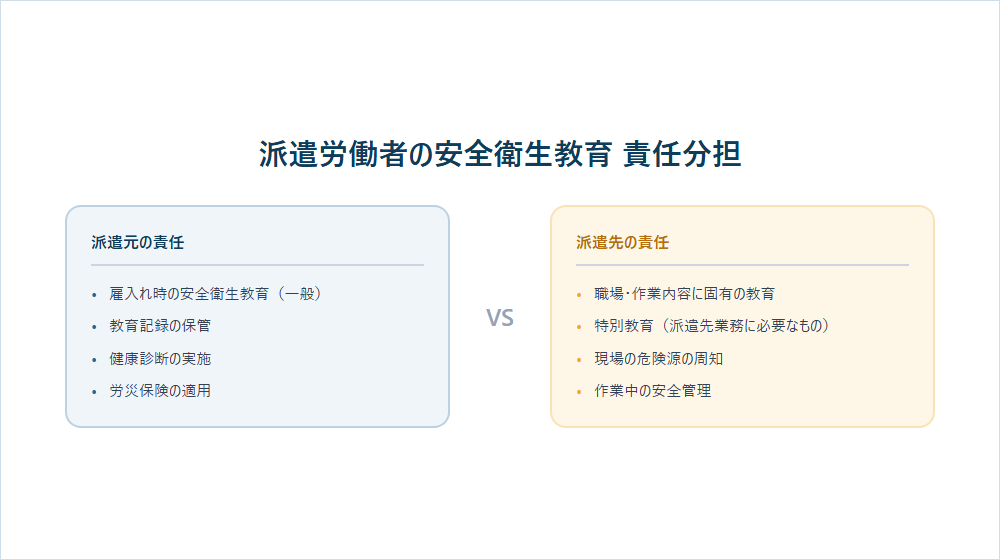
People often ask "isn't the content duplicated between dispatch agency and user company?" Duplication is fine. Rather, the dispatch agency's "industry-common safety awareness and work procedure basics" and the user company's "specific hazards to actually watch out for at this site" have different perspectives, and both are needed. Splitting roles this way works in practice.
Secondment (zaiseki / tenseki)
Let's also organize "secondment," which gets confused with dispatch. Secondment differs legally from dispatch, so responsibility differs.
Zaiseki shukko (concurrent employment — continuing employment with the origin company while also holding employment at the destination) — the mainstream administrative interpretation is that on-hire training duty falls on the destination. Since the worker receives work direction at the destination and engages in the work there, the destination bearing responsibility for safety and health training on that work is rational.
Tenseki shukko (full transfer — terminating employment with the origin and forming a new employment with the destination) is treated as new employment at the destination. The destination bears the full duty to deliver on-hire training for all items.
ⓘ "Same group, so simplify" is dangerous
Some judge "same corporate group, so on-hire training omitted" for intra-group secondments. But employers under ISHA are judged per legal entity. If the legal entity changes, on-hire training subject reapplies even if the work content is the same.
"Hazardous work training" mandatory at the user company
Beyond on-hire training, user companies have a separate training duty to anchor. This is often overlooked — we explain it carefully.
ISHA Article 59 Paragraph 3 states: "When assigning a worker to hazardous or harmful work, special training must be provided." This is special education, with the target work enumerated in Industrial Safety and Health Regulations Article 36 (roughly 60 types of work — forklift operation, arc welding, grinding wheel replacement, slinging assistance, full-harness fall arrest use, etc.).
Responsibility for delivering special education lies with the employer actually assigning the work. In dispatch, the user company is the one assigning hazardous work, so as a principle, the user company delivers special education. If the dispatch agency has already completed special education as part of on-hire training, you can check the completion certificate and omit duplicate delivery at the user company, but if the work content differs from the dispatch agency's time, you must re-deliver at the user company.
Records of who delivered special education and who issued the certificate are always referenced in later accident recognition, so they should be specified in the contract and the individual dispatch contract.
Additional considerations for foreign dispatch workers
When dispatching foreign workers, additional consideration is needed on both dispatch agency and user company sides.
On the dispatch agency side, on-hire training must be delivered in the native language or a language the worker understands. Delivering only formally in Japanese carries the risk of being judged "training that did not substantively take place." Especially in the dispatch industry, where workers move between multiple sites, multilingual standardization of general education at the dispatch agency lightens the additional training burden at each user company.
On the user company side, language support is needed when delivering site-specific training. Even if the dispatch agency completed basic education in the native language, if the site explanation is in Japanese only, site-specific risks won't get through. If the user company has no interpreter, the realistic operation is to coordinate with the dispatch agency to share multilingual training materials / videos.
The worker dispatch contract (individual contract) should specify, for foreign-worker dispatch, the language used, interpreter presence, and responsibility for providing training materials, to prevent later disputes.
Training record retention responsibility
For dispatch / secondment, record retention responsibility is also worth organizing.
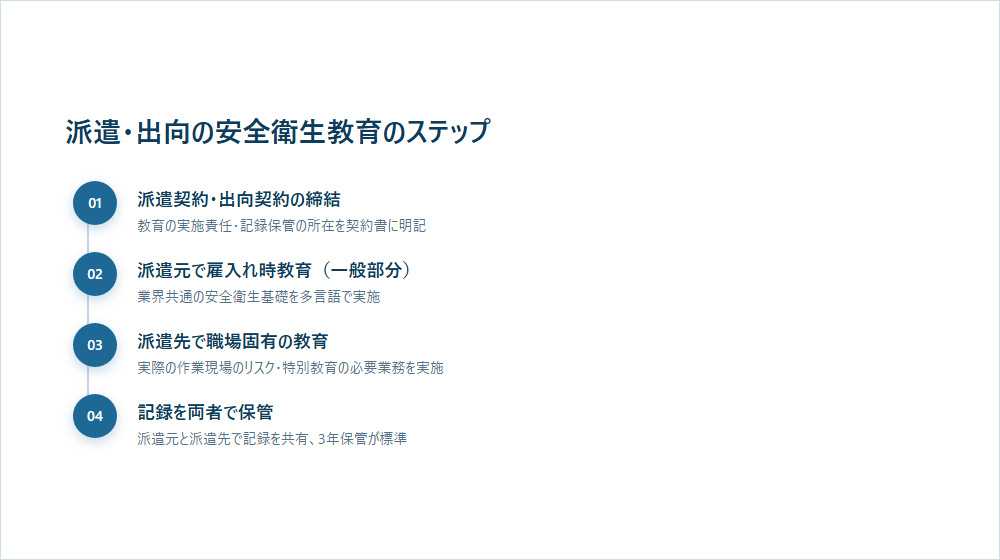
What Industrial Safety and Health Regulations Article 38 directly governs is the 3-year retention of special education records. For on-hire training, 3-year retention is the practical baseline from administrative guidance and accident-handling practice. In dispatch, the party that delivered the training retains the record as the principle. The dispatch agency retains records of general education it delivered; the user company retains records of site-specific training and special education it delivered.
However, when a dispatch worker's accident occurs, inspectors will request records from both the dispatch agency and the user company. The practical operation is to specify in the individual dispatch contract "training records are shared and provided mutually," and to agree on mutual retention for 3 years (preferably 5 years) even after resignation or contract end.
⚠️ Missed handover at end of dispatch
Cases exist where, after the dispatch contract ended, the user company judged "no longer our concern" and discarded the records — and years later, accident recognition could not be proven. Practice safety by reconciling record handover at end of dispatch within 3 months of work termination.
Actual trouble cases
Three real cases of trouble arising in dispatch / secondment safety training. Map them against your situation.
First: "the dispatch agency skipped general education". When a dispatch worker was caught in a machine at a manufacturing user company, checking the dispatch agency's on-hire training records revealed they had sent the worker to the user company the day after contract date, fully delegating on-hire training to the user company. The labor inspector cited the dispatch agency's violation of ISHA Article 59 Paragraph 1, and the dispatch agency employer was referred to prosecutors.
Second: "the user company assigned work without confirming special education completion". After a forklift dispatch worker caused an accident at a logistics site, investigation revealed the worker hadn't received forklift special education at the dispatch agency, yet the user company put them on the lift without checking the completion certificate. The user company employer received guidance for violating ISHA Article 59 Paragraph 3.
Third: "foreign dispatch worker's lack of comprehension". A foreign dispatch worker at a construction site nearly fell during work at height, and it emerged they had not understood how to use the safety harness (full-harness). The dispatch agency's full-harness special education was delivered in Japanese only, and although the worker had signed "I understood," they actually did not understand the technical terms. The substantive nature of the dispatch agency's training is being questioned.
Labona's coverage
→ Contact Labona (dispatch industry demo also)
Summary
Key points for on-hire training at dispatch / secondment destinations, restated:
The on-hire training duty falls in principle on the dispatch agency for dispatch, the destination for tenseki shukko, and the destination for zaiseki shukko. The user company has the special education duty for hazardous work, delivered under the user company's responsibility. The party that delivered training retains the record for 3 years; mutual sharing in the individual dispatch contract is practical. For foreign dispatch workers, language support is needed both at the dispatch agency for general education in the native language and at the user company for site-specific training.
Rather than formal responsibility split, design back from "what can be proven by records if an accident happens" and have both sides retain records — that's the safe operation.
FAQ
Q1. Can the dispatch agency delegate on-hire training to the user company?
The dispatch agency's responsibility is assigned to the dispatch agency employer under Worker Dispatch Act Article 45, so even with delegation as a business outsourcing form, the final delivery responsibility remains with the dispatch agency. It is possible to have the user company provide the training records to the dispatch agency and retain them as the dispatch agency's records, but confirming the content meets the 8 items of Industrial Safety and Health Regulations Article 35 is the dispatch agency's responsibility.
Q2. Is on-hire training needed for short dispatches of about a week?
Yes. ISHA Article 59 Paragraph 1 applies regardless of employment duration. For short dispatches, you can compress training time to the regulatory minimum, but you cannot omit special education when assigning hazardous work. Industries that frequently use short dispatches operate more smoothly by keeping multilingual e-learning constantly available on the dispatch agency side.
Q3. If dispatched again from the same dispatch agency to the same user company, is re-delivering on-hire training necessary?
If the employment relationship with the dispatch agency continues (employment continues after the previous dispatch ended), re-delivery of on-hire training is unnecessary. However, if the work content changes, "training upon work content change" (ISHA Article 59 Paragraph 2) applies. If the employment relationship with the dispatch agency was severed and reconcluded, it's treated as new employment and on-hire training is needed again.
Q4. With zaiseki shukko where wages are paid by the origin company, who bears the on-hire training responsibility?
The location of wage payment and the responsibility for safety and health training are separate issues. For zaiseki shukko, the mainstream administrative interpretation is that the destination — where the worker actually receives work direction and engages in work — bears the training duty. Specify the training delivery responsibility in the secondment contract and coordinate between origin and destination so there's no duplication.
Primary references
- Industrial Safety and Health Act Article 59 (Safety and health training) — search "労働安全衛生法" on e-Gov law search
- Industrial Safety and Health Regulations Article 35 (Training on hire etc.) / Article 36 (Work requiring special education) / Article 38 (Retention of special education records) — search "労働安全衛生規則" on e-Gov law search
- Worker Dispatch Act Article 45 — search "労働者派遣事業" on e-Gov law search
- MHLW notices on "Ensuring the safety and health of dispatch workers" — search "派遣労働者 安全衛生" on the MHLW website