
"We're putting foreign workers on tasks that require full-harness — do we need to deliver the special education in their native language?" We get this question often from construction and manufacturing managers. The regulations require delivery "in a way the worker can understand." If you train someone whose native language is not Japanese only in Japanese, the risk of breaching the duty of care for safety (the state of having failed the company's responsibility to protect workers from danger) remains.
This article organizes how to deliver, in concrete terms, the full-harness fall arrest equipment special education fully mandated since January 2022, when conducted multilingually for foreign workers.
Who this guide is for: HR, legal, and on-site managers at Japan-based employers (or Japan operations of multinational companies) employing foreign nationals in Japan. This guide explains Japan's labor law and Japan-specific operational reality — not US OSHA or any other jurisdiction.
What is full-harness special education
Let's first organize "what training is this?" Some readers can skip this section, but in foreign-worker employment, the terminology itself is sometimes unfamiliar, so we lay the foundation first.
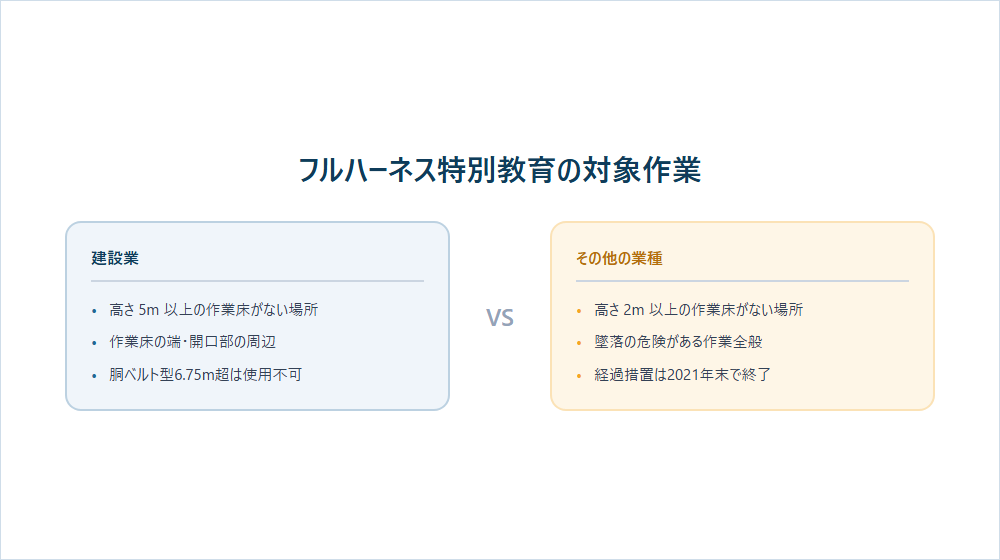
Full-harness special education is training based on Industrial Safety and Health Act Article 59 Paragraph 3 (the provision obligating employers to provide special training to workers engaged in hazardous work). The scope: all workers using full-harness fall arrest equipment to work at "places with no work floor at heights of 2 meters or above" or "the edges of work floors, openings, and other places with risk of falling."
ⓘ The difference between "full-harness" and "waist-belt" types
The waist-belt type (the older type supported only at the waist) carries a high risk of internal injury upon fall, and its use above 6.75 meters was, in principle, prohibited. The full-harness type supports the body with multiple belts including thigh, chest, and shoulder, distributing impact.
→ Request Labona's safety e-learning materials
Background of the mandate and target work
This section explains why the regulation changed and gives you criteria to judge whether your site is in scope.
The June 2018 revision of the Industrial Safety and Health Regulations made full-harness use the principle at heights above 6.75 meters. The duty to use fall arrest equipment itself, as a rule, arises in places without a work floor at heights of 2 meters or more. For scaffolding work in construction, a separate rule mandates use above 5 meters — application thresholds vary by industry and task.
After the transitional period, full mandatory enforcement began on January 2, 2022. "Veteran workers who only ever used the waist-belt type" — as long as they use the full-harness type, they are subject to the special education. Age and experience are irrelevant.
A common on-site request: "We want to train veteran Japanese workers and new foreign workers together." Joint training itself is not a problem, but responsibility for ensuring comprehension lies with the employer. Mixing foreign workers into Japanese-only group training and "treating them as trained" carries the case-law risk discussed below.
Curriculum (academic + practical)
What specifically to teach. Total time is at minimum 4.5 hours academic + 1.5 hours practical = 6 hours.
Academic mandatory items are listed in Industrial Safety and Health Regulations Article 36 Item 41, organized in four areas:
- Knowledge about the work (1 hour) — work at heights of 2m+, structure of work floors using full-harness
- Knowledge about fall arrest equipment (2 hours) — types, structure, part names, inspection methods
- Knowledge about accident prevention (1 hour) — past fall cases, site-specific risks
- Related laws (0.5 hours) — applicable provisions of the Industrial Safety and Health Act and Regulations
The practical portion is 1.5 hours, conducting attachment, adjustment, and inspection of fall arrest equipment on actual equipment.
⚠️ Cases where academic partial omission is allowed
If the worker has a certain number of years of "safety belt" (old type) experience and meets specified work experience, partial omission of the academic portion is allowed. However, the employer must prove the omission criteria, and document preparation is labor-intensive. For new foreign-worker employment, "deliver the full course" generally keeps the responsibility chain clearer when an accident happens.
Three walls in multilingual delivery
"We teach in Japanese, but we're not confident the worker actually understood." If you have that sense, you have already taken the first step toward countermeasures. Three walls you commonly hit in multilingual delivery:
The first wall is material quality. Commercial safety and health training videos often have Japanese narration + subtitles, and full audio coverage in Vietnamese, Indonesian, or Tagalog is the minority. With subtitles only, foreign workers concentrating on gestures and equipment movement during the practical portion tend to skip the subtitles.
The second wall is terminology translation gaps. Technical terms like "lanyard," "fook hook engagement," or "retractor" come out unnatural when machine-translated. Design that combines Japanese terms used on the floor (e.g., keeping "lanyard" as a Japanese loanword in Katakana) with native-language explanations of meaning is needed.
The third wall is comprehension verification. Issuing a completion certificate does not, by itself, constitute fulfillment of the duty of care if the worker only nodded "I understand." Simple native-language tests or replication practical (have the worker actually wear the equipment and hook in) are needed.
State of materials by language
A frequent question: "Which Vietnamese-language material is good?" As of May 2026, here's what Labona editorial confirmed.
- Vietnamese: Translated documents from national / local government exist (MHLW "Multilingual safety and health training materials for foreign workers"). For video content covering all items of full-harness special education, commercial paid materials are the mainstay.
- Chinese (Simplified): Same as above. OTIT (Organization for Technical Intern Training) translation documents exist.
- Indonesian: Official translation documents are limited. Video materials are mostly commercial e-learning.
- Tagalog: A domain with thin supply both publicly and commercially.
- English: A relatively rich range of choices, though materials explaining "Japan-specific standards" in English are few.
The "they speak English, so let them take it in English" approach holds if the worker is more proficient in English than their native language, but many workers from Southeast Asia struggle with technical-term comprehension outside their native language. The iron rule on site: confirm the worker's preference and work history when choosing the language.
Who instructs the practical portion?
Even if academic is finished via e-learning, the 1.5 hours practical requires hands-on instruction on real equipment. Who instructs is a common pain point.
Under the regulations, qualification requirements for special-education practical instructors are not strictly defined. However, MHLW notices state "a person with work experience and sufficient knowledge and skill" is desirable. In practice, on-site safety and health supervisors / foreman-class personnel often serve as instructors.
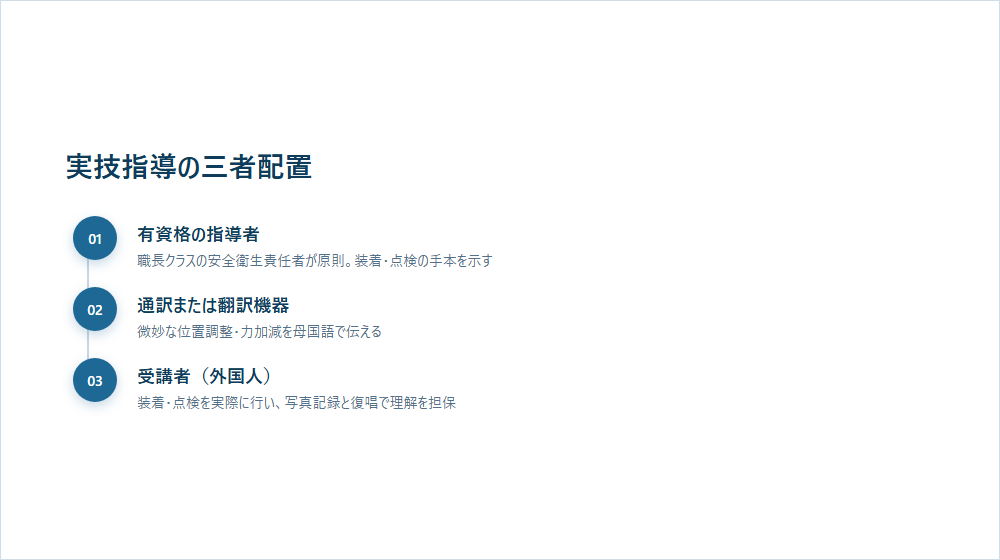
Three points to anchor in practical instruction for foreign learners:
- Interpreter presence (or use of interpreter equipment) — to reliably convey nuanced instructions like "the hook engagement position is slightly off"
- Photo records — confirm the completed attachment state together with the worker; record in photos
- Restatement — have the worker say "the hook goes here on the structure, you taught me" in their own words
If you have on-site experience, you'll know: seasoned instructors tend to rely on gestures, but foreign learners need verbalization. This is not "consideration for less capable people" — it's "a necessary procedure whenever cross-cultural communication is involved, no matter who the counterpart is."
Record management
After delivering special education, you have a 3-year retention obligation under Industrial Safety and Health Regulations Article 38. Items to record:
- Learner name (for foreign workers, including the Romaji as on the passport is safer)
- Date of delivery
- Provider name and contact
- Training content (per-item academic time, content of practical)
- Materials used (for e-learning, material name and language)
Many cases still keep paper registers, but once foreign-worker employment reaches three digits, paper can't keep up. When migrating to digital management, choose a mechanism that guarantees 3-year tamper-resistance (timestamps, update logs).
ⓘ Case of inspector corrective guidance due to record gaps
Cases have been reported from labor inspectors nationwide where the employer verbally said "we delivered the training," but documents could not be found — and as a result it was judged "the training is not recognized as having been delivered." Records are predicated on existing, and maintaining a "find it instantly" state is what matters.
Labona's coverage
→ Contact Labona (full-harness roadmap inquiries also)
Summary
Key points for delivering full-harness special education to foreign workers, restated:
4.5 hours academic + 1.5 hours practical are needed; age and experience do not allow omission. For multilingual delivery, the three keys are: video with native-language audio, response to terminology translation gaps, and post-delivery comprehension verification. Practical instruction is delivered by qualified personnel on site; comprehension is secured with interpreter, photo records, and restatement. Training records are retained for 3 years in tamper-evident form.
Running "we delivered in Japanese so we're legally fine" is a gamble given recent case-law trends. Deliver training in a form the worker can understand, and leave evidence of comprehension. Cement these two and you reduce both the risk of fall accidents and legal risk simultaneously.
FAQ
Q1. Do veteran workers need to take the training?
Yes, they do. Long experience with the older "safety belt" (waist-belt type) is not a basis for omission. The full-harness type differs in both structure and donning method. Since the transitional period ended in January 2022, as long as they use the full-harness type, attending the special education is mandatory.
Q2. Is it possible to deliver academic via e-learning and practical as group training?
Yes. In fact, it's a rational structure when considering multilingual delivery. Completing native-language academic video + comprehension test via e-learning, with only the practical conducted on site by qualified personnel individually or in small groups, is becoming the standard pattern for companies employing foreign workers.
Q3. Are there documents to submit to the inspector?
No periodic submission obligation. During labor inspector spot checks (an unannounced inspection by the inspector at the site) or upon accident, "presentation of delivery records" will be requested. The practical minimum is to retain them in a presentable state at any time for 3 years.
Q4. How many people can be trained at one time?
No regulatory upper limit. However, since practical requires watching attachment and inspection per person, the practical ceiling per instructor is 5–10 learners. If you exceed that, increase instructors or split into sessions.
Primary references
- Industrial Safety and Health Regulations Article 36 Item 41 (Scope of special education) — search "労働安全衛生規則" on e-Gov law search
- MHLW "Guidelines for the safe use of fall arrest equipment" — search the MHLW website
- MHLW multilingual safety and health training materials for foreign workers — refer to "Labor standards & safety and health" on the MHLW website