
"We want to put foreign workers on crane lifting work, but how do we get them slinging qualified?" — a question we hear monthly from construction, manufacturing, and logistics managers. At the 1-ton threshold the training type changes, and one of them can only be taken at a registered training organization. How you secure multilingual delivery shifts deployment speed substantially.
This article organizes, in roughly 3,000 Japanese characters of source, the boundary between slinging skills training and special education, practical steps to put foreign workers through skills training, and the current state of multilingual options including Vietnamese and Chinese.
Who this guide is for: HR, legal, and on-site managers at Japan-based employers (or Japan operations of multinational companies) employing foreign nationals in Japan. This guide explains Japan's labor law and Japan-specific operational reality — not US OSHA or any other jurisdiction.
The "skills training" vs "special education" boundary (1-ton)
This section organizes how the type of training splits at the crane's lifting capacity. Citing the regulations, we give you the decision axis for which applies to your site.
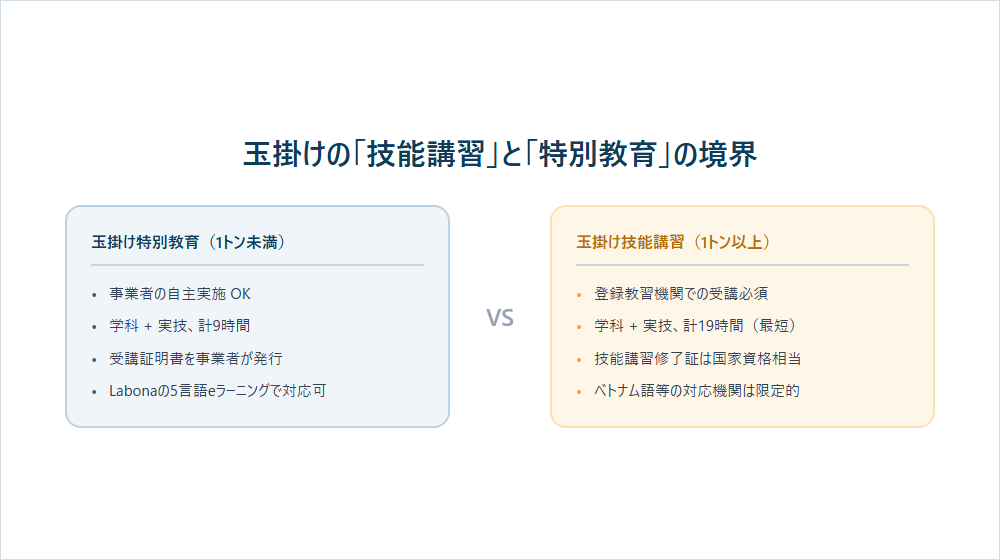
Slinging work has a two-tier training system under Industrial Safety and Health Act Article 61 and Industrial Safety and Health Regulations Article 36 Item 19. If you do slinging on cranes, mobile cranes, or derricks with lifting capacity of 1 ton or more, completing skills training (a course equivalent to a national qualification under Article 61) is mandatory. Under 1 ton, the employer-conducted special education (under Industrial Safety and Health Regulations Article 36 Item 19 — safety training for workers in hazardous work) suffices.
"Lifting capacity" is the crane's own maximum capability. Note that the determination uses the crane's rated capacity, not the weight of the load lifted. Even at a site only lifting 500 kg loads, if the crane used has a lifting capacity of 2 tons, slingers must hold the skills training completion certificate.
ⓘ "Slinging" and "crane operation" are separate qualifications
Slinging is the work of attaching ropes or slings to a load for the crane to lift. Crane operation is a separate qualification system, also split into operator's license / skills training / special education by lifting capacity. If one person does both, they need both qualifications.
→ Request Labona's safety e-learning materials
Skills training: requirements and hours
This section organizes the requirements, hours, and completion-test structure of skills training — information to judge "can our technical interns take it?"
The slinging skills training curriculum is set in Industrial Safety and Health Regulations Appendix Table 6. Academic 19 hours + practical 8 hours = 27 hours total. The standard schedule is the shortest 3 days, with some training organizations splitting into 4–5 days.
Academic content is organized in 4 areas:
- Knowledge about cranes and equivalent (1 hour)
- Knowledge of mechanics required for slinging cranes (3 hours)
- Methods of slinging cranes (7 hours)
- Related laws (1 hour)
- Completion test (academic)
Practical is 8 hours covering signaling for crane operation and slinging methods (attaching/detaching wire ropes, identifying load center) on actual equipment, ending with a completion test.
Eligibility: 18 or over, no nationality requirement. Foreign workers with work-eligible residency status — technical interns, specified skilled workers, "engineer/specialist in humanities/international services," etc. — can take it. There are provisions for partial academic omission (for crane operator's license holders, etc.), but for new foreign-worker employment, plan for the full course as a principle.
⚠️ If you fail the completion test
Failing either the academic or practical test requires a retake of that subject or full re-enrollment. Responses vary by training organization, so confirming "remedial measures if failed" before applying gives peace of mind.
Flow of taking training at a registered training organization
This section shows the practical procedure to put a worker through skills training, step by step. We include the timing of multilingual-availability checks.
Skills training can only be taken at a registered training organization. A registered training organization is a private training facility registered with the prefectural labor bureau — the Japan Construction Occupational Safety and Health Association, each prefecture's Crane Association, and private heavy-equipment training centers are representative examples.
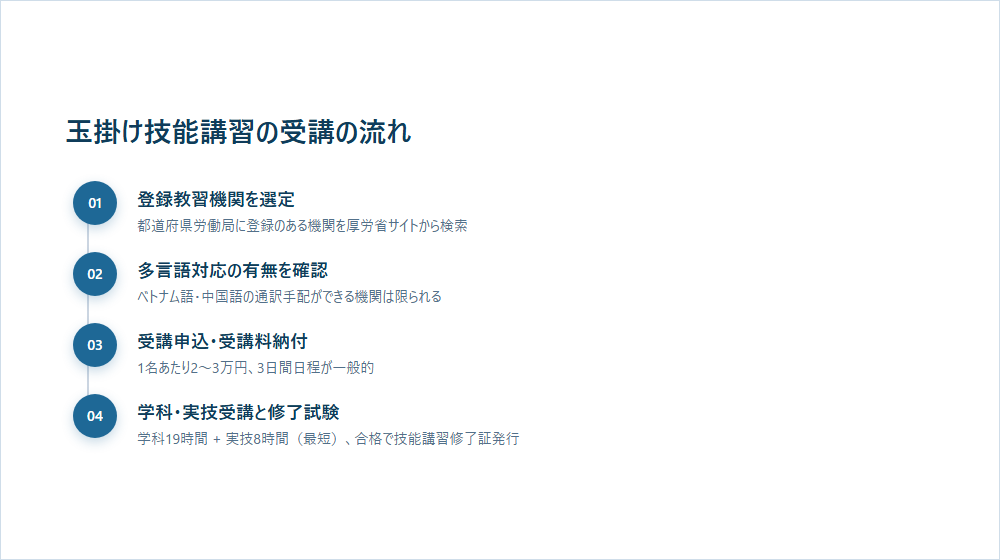
The practical flow up to receiving training, in 4 steps:
Step 1: Choose the organization. Check the list of registered training organizations on the MHLW page or the prefectural labor bureau's site for those offering slinging skills training. Filter by region, schedule, fees, and capacity.
Step 2: Confirm multilingual support. As discussed below, organizations that can arrange Vietnamese or Chinese interpreters are limited. The reliable approach is to call directly and ask "can a foreign learner attend with an interpreter present?" and "is native-language instruction by a designated lecturer possible?"
Step 3: Apply and pay. Around 20,000–30,000 yen per person, 3 days standard. ID documents like a copy of residence record or residence card are commonly required at application.
Step 4: Take academic + practical and the completion test. Receive 3 days (academic 19 hours + practical 8 hours), with the completion test on the final day. On passing, the skills training completion certificate is issued — this is the proof of being able to perform slinging work.
Finding multilingual training organizations
The most frequent question from on-site managers: "Where can slinging skills training be taken in Vietnamese?" Per the May 2026 picture confirmed by Labona editorial.
Organizations that can complete skills training in the native language are currently few. Three reasons. First, conducting the completion test in the native language requires the training organization to set up translation and grading for test questions — operationally expensive. Second, lecturers who can teach safety terminology in native languages are limited. Third, under the registered training organization system, changes to curriculum and materials require filing with the labor bureau — a structure that makes flexible localization slow.
In reality, situations consolidate into the following patterns:
- Japanese group training + interpreter on-site: most common. The employer or learner arranges an interpreter who translates the instructor in real time.
- Dedicated schedules in specific languages: some organizations offer Vietnamese or Chinese-only sessions in season-limited windows (e.g., before construction's busy season).
- On-site delivery to the training organization: if learners come together, the training organization travels to the worksite with an interpreter.
There is no organization that says "available in Vietnamese anywhere nationwide." Regional differences are large; the realistic move is to contact multiple organizations within commuting range of your site.
Attending with an interpreter on-site
When you have a worker take training with an interpreter present, two practical points commonly trip people up: "who arranges the interpreter" and "how does the interpreter relate to the completion test." Let's organize.
Interpreter arrangement differs by training organization. Most often, "please bring an interpreter yourself" is the answer. Training organizations rarely refer interpreters. Either request interpreters from the supervising organization of technical interns, or use an external industrial interpreting service. Cost benchmark: 30,000–50,000 yen per day.
How the interpreter relates during the completion test must follow the training organization's rules. Most organizations don't allow interpreter intervention during the academic test; some allow "safety-direction interpretation" during the practical test. Always confirm "interpreter presence rules during the completion test" at application.
ⓘ Interpreter quality drives results
Technical terms like mechanics, load calculation, and wire strength suffer frequent mistranslation in generic interpreting. Where possible, choose "an interpreter with experience in crane and slinging fields." Sharing the materials in advance to align terminology alone significantly changes comprehension during training.
What the skills training completion certificate means
This section clarifies the legal standing of the skills training completion certificate and how it differs from the special education completion certificate.
The skills training completion certificate is a certificate equivalent to a national qualification under Industrial Safety and Health Act Article 61. The issuer is the registered training organization, but the basis is in the regulations — valid at any employer nationwide. Effect remains after job change. There is no carrying obligation, but in case an inspector or prime contractor asks for it on site, having a personal copy is safer.
The special education completion certificate (issued by the employer independently) is an internal document supporting employment at that employer. Its statutory effect is not as strong as the skills training certificate, and on job change a new employer may re-deliver the training.
For foreign workers, the name on the skills training completion certificate is often issued using the Romaji spelling on the passport. Be cautious during identity matching when this differs from the kanji on the residence card.
⚠️ Risk of forgery / use of another person's certificate
Forgery or use of another's skills training completion certificate is both an Industrial Safety and Health Act violation and forgery of private documents. This rarely surfaces as an issue in construction; don't skip in-person verification of the original and inquiry to the issuing training organization at hiring.
Labona's coverage (we cover special education; skills training is the training organization's domain)
Summary
The slinging training system splits at the 1-ton boundary between skills training and special education. Skills training must be taken at a registered training organization — academic 19 hours + practical 8 hours = 27 hours total. The mainstream multilingual approach is "Japanese training + interpreter present"; Vietnamese / Chinese-dedicated schedules are regionally and seasonally limited.
When putting foreign workers through skills training, confirm multilingual availability directly when selecting the organization, and align interpreter arrangement, completion-test rules, and costs before applying. The completion certificate is a national-qualification-grade document — don't skip in-person verification and issuer inquiry at hiring.
Skills training is outside Labona's scope, but special education (under 1 ton) and the multilingual delivery of on-hire training to complement skills training are within our scope. Use them apart in your overall design for assigning foreign workers to crane work.
FAQ
Q1. Can technical interns take slinging skills training?
Yes, they can. Eligibility is 18 or over, with no nationality requirement. Any worker on a work-eligible residency status — Technical Intern, Specified Skilled Worker, "Engineer/Specialist in Humanities/International Services," etc. — qualifies. However, the supervising organization's prior approval is sometimes required, so for technical interns, consult the supervising organization before applying.
Q2. Is the slinging skills training certificate valid at other employers after a job change?
Yes. The skills training completion certificate is a certificate equivalent to a national qualification under the Industrial Safety and Health Act and is valid nationwide regardless of issuing organization or employer. No need to re-take at the new employer. The standard operation is for the worker to keep the original and present it to the new employer.
Q3. Isn't taking skills training overkill when special education would suffice?
Not overkill. In practice, considering the possibility that on-site crane equipment may change in the future to handle 1 ton or more, having workers take skills training gives more flexibility in assignment. Decide by weighing cost against future business scope.
Q4. Are there training organizations that conduct training in the native language?
Some organizations hold dedicated schedules in specific languages in season-limited windows. Do not assume "available nationwide in the native language." The reliable approach is to call your nearest registered training organization and ask "do you have Vietnamese (or Chinese)-supported schedules?" and "is interpreter presence allowed?"
Primary references
- Industrial Safety and Health Act Article 61 (Skills training) — search "労働安全衛生法" on e-Gov law search
- Industrial Safety and Health Regulations Article 36 Item 19 (Slinging special education) — search "労働安全衛生規則" on e-Gov law search
- MHLW "List of registered training organizations" — search the MHLW website