
For HR officers whose foreign-worker headcount has been growing, the first sticking point in localizing safety and health training is "which language do we start with?" Budgets are limited, and standing up five languages at once is not realistic. This article organizes nationality data, industry-specific priorities, and the staged rollout plan — from picking the first language to expanding to five.
Who this guide is for: HR, legal, and on-site managers at Japan-based employers (or Japan operations of multinational companies) employing foreign nationals in Japan. This guide explains Japan's labor law and Japan-specific operational reality — not US OSHA or any other jurisdiction.
Decision criteria for localization
The task is not "line up every language" but "prioritize by business risk and training effectiveness."
The Industrial Safety and Health Act Article 59 mandates the delivery of safety and health training but does not say "in Japanese." On the other hand, the MHLW's position is that training in a language the learner cannot understand is "not considered training delivered." Three decision axes apply:
- Share by nationality — prioritize the language with the largest population at your company
- Business risk — prioritize nationalities engaged in work where misunderstanding directly leads to accidents (work at height, machinery operation, hazardous material handling)
- Residency length — short-term workers especially benefit from native-language materials directly tied to safety
ⓘ "Prioritized by risk" beats "equal across all languages"
Standing up all languages at once leaves every language half-finished. Getting the first language into operation and then expanding produces higher on-site effectiveness.
→ Request Labona's safety e-learning materials
Worker share by nationality (2024 data)
According to the MHLW's "Notification of Foreign Worker Employment," the top 4 countries account for about 65%.
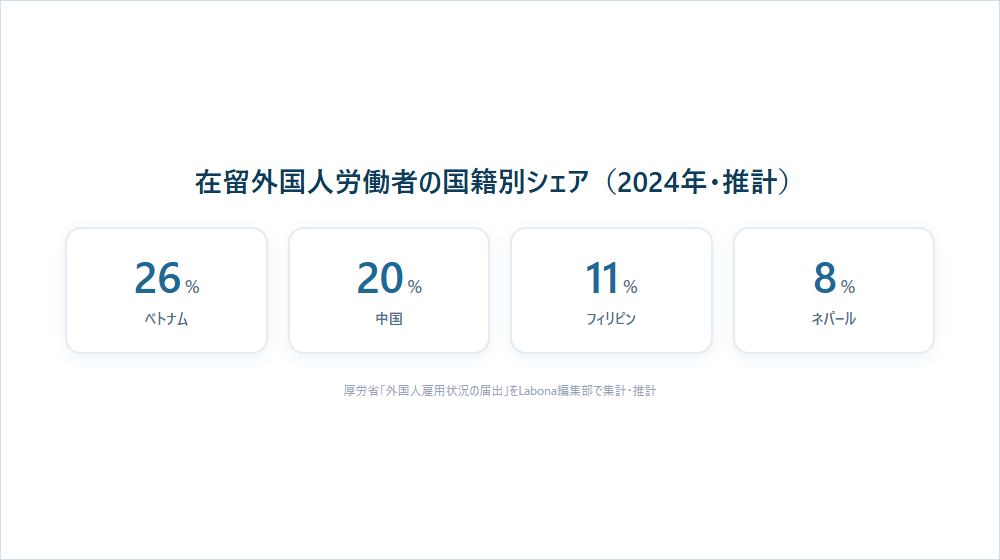
Vietnamese nationals lead at about 26%, Chinese at about 20%, with Filipino and Nepali at around 10% each. The top 4 countries cover two-thirds of all foreign workers.
That said, this share varies by industry and region. Vietnamese stand out in construction; in automotive parts within manufacturing, Chinese and Filipino are more prominent. In logistics and warehousing, Nepali and Vietnamese are growing. Rather than mechanically saying "26% nationally so we start with Vietnamese," first tally your own employment data.
Note: the figures above are Labona editorial estimates. For the official latest, search "Foreign worker employment" on the MHLW website.
Industry-by-industry differences in language priority
Different industries, different priority languages. Confirming your industry composition before choosing a language is the iron rule.
Construction
Vietnamese nationals often exceed 40%, followed by Chinese and Indonesian. The high ratio of technical interns and trained workers (ikuseishu) means native-language training including on-site terminology is directly tied to accident prevention. The standard pattern is Vietnamese first, then Chinese or Indonesian.
Manufacturing
In automotive parts and electronics, Vietnamese, Chinese, and Filipino each hold roughly 20%. In food manufacturing, Vietnamese, Indonesian, and Myanmarese are growing, with composition varying by line. If a single language cannot cover 30%, building two languages simultaneously can be cheaper in the end.
Logistics & warehousing
Workers from Vietnam, Nepal, Sri Lanka, and Myanmar are growing. Forklift and material-handling training require language matching because mismatch can be fatal — prioritization tied to business risk is essential.
The "English will do" trap
The plan to "use English to cover everyone" almost never works in practice.
The English ability of technical interns and trained workers is far lower than imagined. In sending countries like Vietnam, China, Nepal, and Myanmar, study hours for Japanese exceed those for English in many cases, and workers who can understand safety-and-health technical terms in English are a minority. The image of "foreigners speak English" fits high-skilled talent from the Philippines, India, or Malaysia, but not field-level workers.
ⓘ Treat the English version as a "supporting language"
Putting up English alone without a native version does not raise on-site comprehension. The realistic answer is to center the native version and position the English version as support for managers and interpreters.
Four steps for language selection
Four steps to keep your in-practice decision on track.
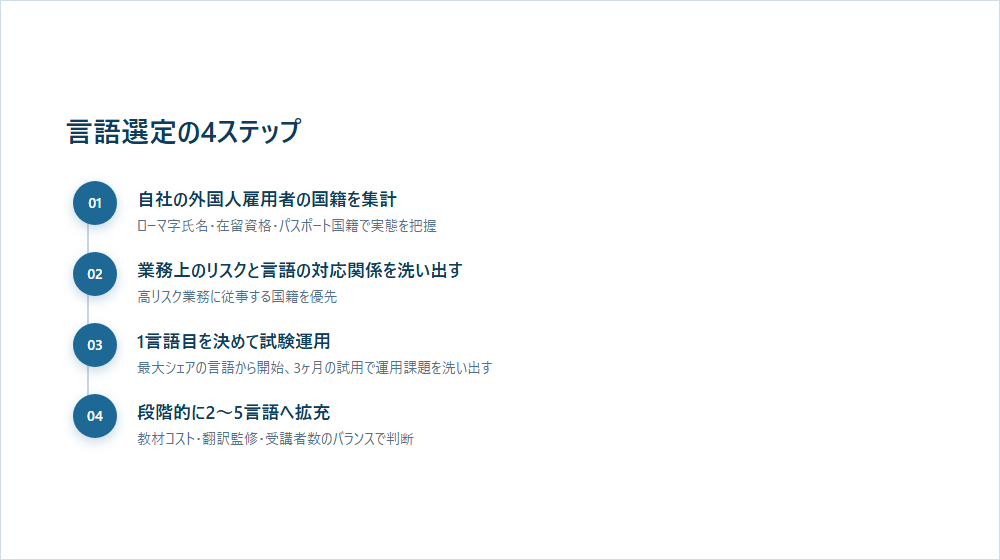
Step 1: Tally the nationalities of your foreign workers
Quantify your employment reality. Including residency status and passport nationality, tally side by side: past 2 years, past 1 year, outlook for the next 1 year. Romaji names alone don't reveal nationality, so setting up nationality codes in your HR system makes things easier later.
Step 2: Map business risk against language
Cross nationality with the risk level of the work. For work where misunderstanding directly leads to accidents (forklift, work at height, organic solvent handling), there's a case for raising the priority of the workers' nationality even if their headcount is smaller.
Step 3: Pick the first language and pilot
Pick the first language and run a 3-month pilot. What surfaces: translation quality, learner comprehension, operational flow (device distribution, completion records, Q&A). Whatever trips you up here trips you up again in the second language.
Step 4: Stage expansion to 2 to 5 languages
After surfacing operational issues, expand to a second and third language. Translation supervision, content revisions, and learner management costs accumulate, so plan within the annual budget.
How to assure translation quality
Low translation quality risks "training was not delivered" being a defensible finding. Four practical priorities:
- Engage native speakers with safety-and-health field experience as reviewers
- Set up a glossary of technical terms (lock industry-specific terms like "fall arrest equipment" or "serious accident" internally)
- Verify alignment with on-site terminology (textbook translations and on-site phrasing often diverge)
- Verify comprehension with post-completion tests (translation problems always show up in the correct-answer rate)
"Outsource everything to a translation vendor" hurts later. Build in a workflow where in-house foreign staff review beforehand.
How to stage expansion (1 language → 2 → 5)
Standing up 5 languages from the start is unrealistic. Labona recommends staged expansion on a 6-to-12-month cadence, adding one language at a time.
- Phase 1 (0–3 months): Get Japanese + first language operational. Vietnamese for construction; Chinese for automotive parts manufacturing; Vietnamese or Nepali for logistics — these are the candidates.
- Phase 2 (3–9 months): With operational issues from the first language fed back, add the next-largest language. Lead times for revision flow and translation supervision are measured, so deployment is quicker.
- Phase 3 (9–18 months): Add Filipino, Indonesian, Nepali, or Myanmarese based on industry traits. Prioritizing by learner count is the principle, but cases exist where a high-risk minority language is built first.
ⓘ "Wait until all languages are ready" is a failure pattern
Preparing for over a year "to start with 5 languages ready" leaves the first-translated materials outdated by regulatory revisions. Better to get the first language operational in 3 months and add the second while cycling revisions.
Labona's coverage
Labona for Business offers statutory training materials including on-hire training, special education, and full-harness special education. The Japanese version is being published progressively; English, Vietnamese, Chinese, and Indonesian are being expanded.
- Per-course language switching — learners select their native language
- Centralized completion records on the admin dashboard — corporate administrators check completion status by language
- Auto follow-through on regulatory revisions — content-side revisions reflect changes like the 8-item expansion of on-hire training (April 2024)
- Support for staged adoption — plans accommodate phased expansion starting from one language
Priority languages by industry and adoption plans for your nationality composition can be discussed individually upon request.
Summary
Localizing safety and health training is realistic when you prioritize by crossing nationality composition with business risk, get the first language operational within 3 months, then stage expansion. Vietnamese for construction; Chinese or Vietnamese for manufacturing; Vietnamese or Nepali for logistics — these are strong first-language candidates. The notion that "English covers everyone" does not work in practice; we recommend a design centered on native-language versions.
FAQ
Q1. With nationalities scattered (3 Vietnamese, 3 Chinese, 2 Filipino, 2 Nepali), which language do we start with?
Set priority by business risk. If any nationality operates forklifts or works at height, prioritize that language. If risks are level, start with the largest share, then move to the second language after a 3-month pilot. That sequence is workable.
Q2. Is preparing only the English version meaningless?
Not meaningless, but it shouldn't be the main version. The English version has value as a supporting language for managers, interpreters, and high-skilled talent. For field-level technical interns and trained workers, English ability is often lower than expected — centering the English version reduces training effectiveness.
Q3. Is it OK to finish translation with AI (machine translation)?
Not recommended. Safety-and-health technical terms suffer frequent mistranslation in machine translation. For terms like "fall arrest equipment," "serious accident," or "hazardous work," supervision by native speakers with safety-and-health experience is essential. Use AI translation as a first pass; final review by humans is the realistic operation.
Q4. Can we start the second language before the first stabilizes?
Not recommended. If first-language operational issues (revision flow, completion records, Q&A) aren't resolved, the same problems will recur in the second language. Surfacing issues in a 3-month pilot before moving to the second language reduces total effort.
Primary references
- Industrial Safety and Health Act Article 59 (Safety and health training) — search "Industrial Safety and Health Act" on e-Gov law search
- MHLW "Notification status of foreign worker employment" — search the latest version on the MHLW website
- Immigration Services Agency "Resident foreign national statistics" — Immigration Services Agency website