
"We want our Vietnamese staff to operate the forklift. In what language should they take the training?" — a question we hear often from on-site managers in logistics and manufacturing. Many employers just have them sit in on the Japanese group training, but sending workers onto the floor without confirming their actual comprehension makes the responsibility chain complicated if an accident happens.
This article organizes the forklift special education / skills training framework, the state of Vietnamese-language materials, and concrete practical instruction steps. Aimed at companies that want Vietnamese workers running forklifts in warehouses or on manufacturing lines.
The boundary between special education and skills training
First, the two-tier structure of the regulation. People mix up "special education" and "skills training," so let's separate them cleanly.
Who this guide is for: Logistics and manufacturing managers at Japan-based companies employing Vietnamese workers in Japan. This article covers Japan's forklift training requirements under the Japanese Industrial Safety and Health Act — it does not address US OSHA forklift certification.
The Japanese Industrial Safety and Health Act splits forklift training into two by maximum load capacity:
- Special education: forklifts with maximum load capacity under 1 ton. 6 hours academic + 6 hours practical (minimum)
- Skills training (技能講習): forklifts with maximum load capacity of 1 ton or more. 11 hours academic + 24 hours practical (minimum)
Mid-size warehouse forklifts are mostly 1 ton or more, so skills training is what's typically needed on site. On manufacturing lines, smaller machines (compact counterbalance types, etc.) are often under 1 ton — special education suffices for those.
ⓘ If you're not sure which applies, check the manufacturer's spec plate
Maximum load capacity is printed on the vehicle's nameplate (the metal plate near the operator seat). "Max load 850 kg" → special education. "1500 kg" → skills training. The lift type (reach, counterbalance, walkie) does not affect this.
→ Request Labona's safety e-learning materials
Demand for Vietnamese-speaking forklift operators
Why a Vietnamese-specific article? The on-site data backs it.
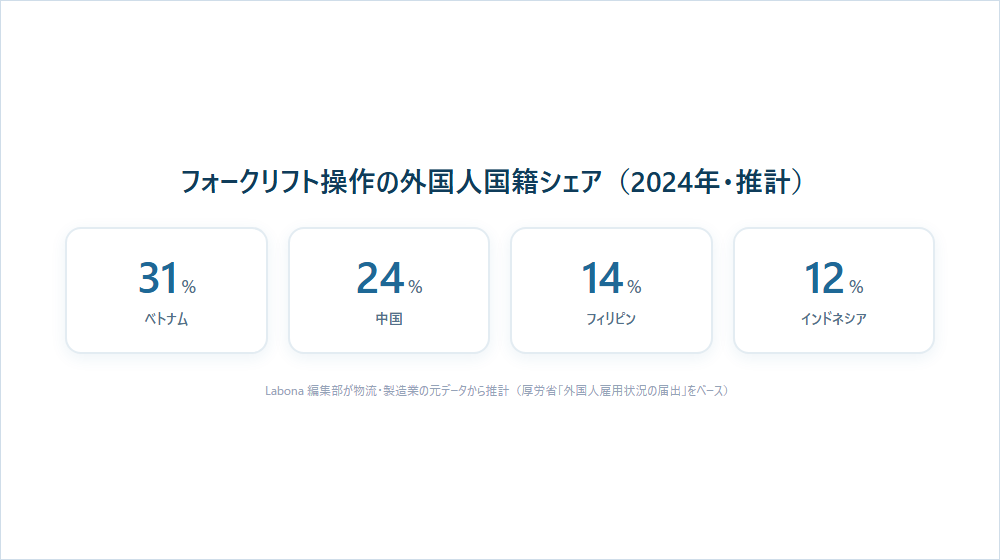
Per the MHLW "Notification status of foreign worker employment," Vietnamese workers outnumber Chinese and Filipino workers and, as of 2024, hold one of the largest workplace shares among resident foreign nationals. Logistics warehouses, food factories, and automotive-parts plants in particular have rapidly built forklift operation into Vietnamese workers' duties.
With the technical intern program transitioning to the ikuseishu (trained worker) program in April 2027, receiving companies are shifting forklift training from "Japanese only" to "native-language alongside Japanese." Drivers behind this shift include stricter guidance from OTIT (Organization for Technical Intern Training) and accumulating case law on accidents involving inadequate Japanese.
State of Vietnamese-language materials
What materials exist in Vietnamese? The Labona editorial team confirmed the following landscape.
The choice of Vietnamese-language academic video material has expanded over the past 5 years. Main providers fall into:
- Official translated documents: text translations from the MHLW and JITCO (Japan International Trainee Cooperation Organization). Video format is limited.
- Commercial e-learning: 3–4 paid services that fully cover videos with Vietnamese audio narration.
- Construction-specialized translated materials: translated booklets from the Japan Construction Occupational Safety and Health Association (not forklift-specific).
Three checkpoints when selecting materials. First, is the audio narrated in Vietnamese? (Subtitles-only rarely works on site.) Second, do the on-site terms work? (We've seen attachment names translated so literally they don't communicate on the floor.) Third, is the comprehension test in Vietnamese?
⚠️ "Show the Japanese video + give Vietnamese-language supplementary handout" is not enough
When the audio is in Japanese, workers focus on reading subtitles and body language, missing the safety alarm cues. As a principle, video materials should be shown with native-language audio from the start.
Designing practical instruction communication
Even if the academic portion is covered by Vietnamese video, the 6 hours of practical instruction are conducted face-to-face by your on-site supervisor. This is the heart of accident prevention.
A working setup for practical instruction with Vietnamese learners:
- 3-language labels: stick Vietnamese / Japanese / English labels on operating levers and pedals.
- Watch → mimic → solo, three stages: do not let learners operate solo immediately. Instead, the learner observes from the rear, then operates with the supervisor riding along, then solo.
- Wireless intercom: when issuing instructions across distance in a warehouse, have a Vietnamese-speaking on-site lead confirm by radio.
- Video recording: record practical operation on video and review together with the supervisor and learner.
The principle isn't "they don't understand the language so they're dangerous" — it's "build a procedure that communicates without relying solely on language." Excellent supervisors convey intent through body movement, gaze, and tone regardless of the learner's language.
Training timing and start-of-work
When during onboarding should training take place? Decide on both regulatory and HR grounds.
Under the regulations, training must be completed before actual forklift operation. "We're in the middle of training, so just a little operation is OK" is a violation. Schedule the training before the day the worker is assigned forklift duties, separately from on-hire safety and health training.
Two practical timing patterns:
- Concentrated 1–2 weeks after joining: 2 days academic via e-learning + 3 days practical on site = 5 days to forklift qualification, then start work.
- Embedded over 3–4 weeks: While doing Japanese-language work, take training 1–2 days per week and start full forklift duties from week 5.
The former is lower in management cost for the employer but heavier on the worker. The latter lets the worker absorb at their own pace, but requires more careful work assignment during the training period.
Accident patterns in warehouse operations
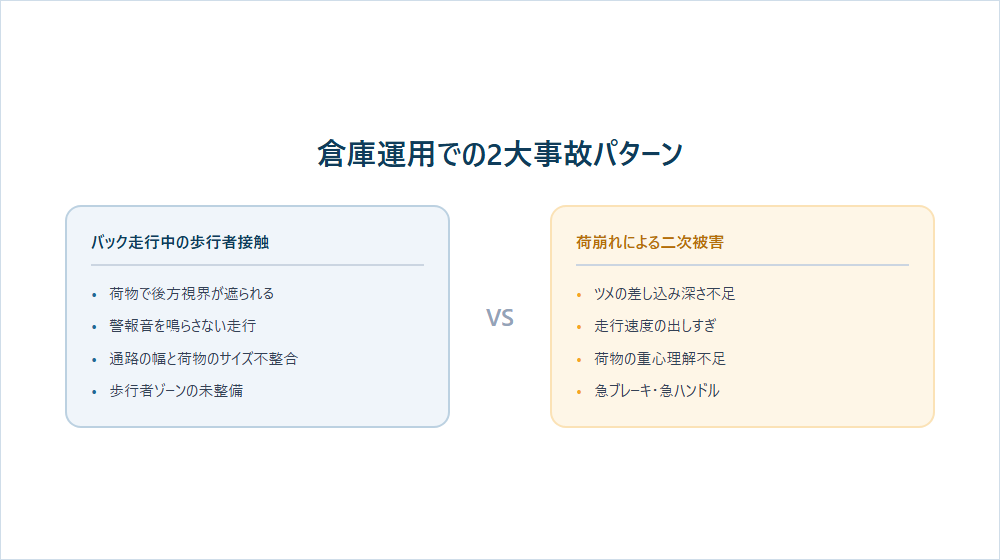
It's not "Vietnamese workers cause more accidents" — it's "anyone with insufficient training will cause accidents." Three common patterns:
First, pedestrian contact during reverse driving. When carrying loads in reverse, rearward visibility checks lapse — this happens regardless of industry. Training should drill "drive with the warning beep on" and "dismount to confirm periodically."
Second, load collapse. Carrying without understanding how to load pallets, then having loads collapse on bystanders during travel. The relationship between load center, fork insertion depth, and travel speed comes across better in Vietnamese-language case-study videos.
Third, lift-to-lift contact. Accidents at intersections of multiple forklifts in a warehouse. Training must cover "how priority is determined" and "unified meaning of warning beeps" with diagrams.
Designing the native-language test
When running the comprehension test in Vietnamese, what should it ask? Practical pointers:
- Beyond simple multiple choice, include identifying hazards in a photograph format.
- "Arrange the steps of correct operation in order" — reproducing on-floor workflow.
- Have the learner read Vietnamese-language "hazard signage" and answer the meaning (testing language comprehension and safety knowledge together).
- Pass threshold 80%+; failed learners receive re-training (do not put them on the floor without comprehension).
Test results are kept as records for 3 years. When conducted via an e-learning system, logs are saved automatically.
Labona's coverage
→ Contact Labona (incl. forklift roadmap inquiry)
Summary
Key points for forklift training with Vietnamese workers, restated:
Confirm the special education (under 1 ton) / skills training (1 ton or more) boundary first. Use native-language audio video for the academic portion; for practical, use 3-language labels, three-stage progression, wireless intercom, and video review. Operation before training completion is a violation; choose between concentrated and staged training timing. The accident patterns are "reverse driving," "load collapse," and "lift-to-lift contact" — design preventive training around Vietnamese-language case studies.
The principle isn't "they can't speak Japanese, so it's dangerous" — it's "build a procedure that conveys meaning beyond language." Every yen invested in training reliably reduces accidents and liability.
FAQ
Q1. Do Vietnamese workers themselves need to obtain a Japanese forklift license?
On completing skills training they receive a skills training completion certificate; on completing special education they receive a completion certificate. These are the proofs of "forklift operating qualification" in Japan. Licenses from their home country have no effect in Japan.
Q2. If they have forklift experience back home, can training be shortened?
The regulations do not permit waiving training based on overseas operating experience. Japan-specific warning beeps, signage, and safety standards must be learned, so even experienced workers go through the full course as a principle. That said, the practical portion often progresses faster, so the supervisor can streamline practical hours at their discretion.
Q3. Which is better, group training or e-learning?
The standard hybrid is: academic via e-learning (native-language video + comprehension test), practical via group instruction on site. Running the academic portion as group training in Japanese only raises the comprehension barrier for foreign workers.
Q4. Can skills training be taken in Vietnamese?
Skills training must be conducted at a registered training organization, and Vietnamese-language registered training organizations are limited. In most cases, learners take Japanese-language training with an interpreter present. Check with the training organization in advance whether interpreter arrangements are possible.
Primary references
- Industrial Safety and Health Act Article 59 Paragraph 3 (Special education) — search "労働安全衛生法" on e-Gov law search
- Industrial Safety and Health Regulations Article 36 Item 5 (Forklift special education scope) — search "労働安全衛生規則" on e-Gov law search
- MHLW "Notification status of foreign worker employment" — search the latest version on the MHLW website