
"I know Ikuseishu starts in 2027, but I can't tell what specifically changes in safety training operations." From mid-sized manufacturing HR officers, we've fielded one such question after another these past few months. The reason is that following only the surface of the program doesn't reveal the answer. Industrial Safety and Health Act (ISHA) obligations don't change, while responsibility for pre-arrival training, retraining at transfer, and prior training in the sending country all shift significantly.
This article compares the Technical Intern program and the Ikuseishu (trained worker) program strictly from the angle of safety training. In about 4,500 Japanese characters of source, we organize it so that preparation officers at receiving companies can reverse-engineer "what to have in place by April 2027."
→ Request Labona's safety e-learning materials
Who this guide is for: HR, legal, and on-site managers at Japan-based employers (or Japan operations of multinational companies) employing foreign nationals in Japan. This guide explains Japan's labor law and Japan-specific operational reality — not US OSHA or any other jurisdiction.
Quick-reference comparison
Before diving into the regulatory details, we sweep through the differences purely from the safety-training angle.
The differences sort into 9 items: foundational law, program purpose, residency duration, transfer possibility, who runs pre-arrival training, content of post-arrival training, on-hire training (ISHA Article 59), special education (Regulations Article 36), and duty of care for safety. Of these, the 3 ISHA-based items don't change; the other 6 shift significantly.
The Technical Intern program is based on the Technical Intern Act, framing "international contribution" up to 5 years with transfer in principle disallowed. The Ikuseishu program, based on the revised Immigration Control Act and the Ikuseishu Act, explicitly states "workforce acquisition" as its purpose, up to 3 years with a designed bridge to Specified Skilled Worker (i). Transfer is permitted under certain conditions for operational inconvenience or the worker's intent.
Key points
- The 3 ISHA-based items (on-hire training, special education, duty of care) don't change
- Pre/post-arrival role-split and transfer possibility shift significantly
- Under transitional measures, both program workers will coexist on site for some time
People sometimes assume "technical interns will switch over to Ikuseishu directly," but under transitional measures, those who are in Japan as technical interns are treated as technical interns until the end of their residency. So after April 2027, both program workers will coexist on site for some time.
Safety training under Technical Intern
This section reviews the current safety training operation under the Technical Intern program.
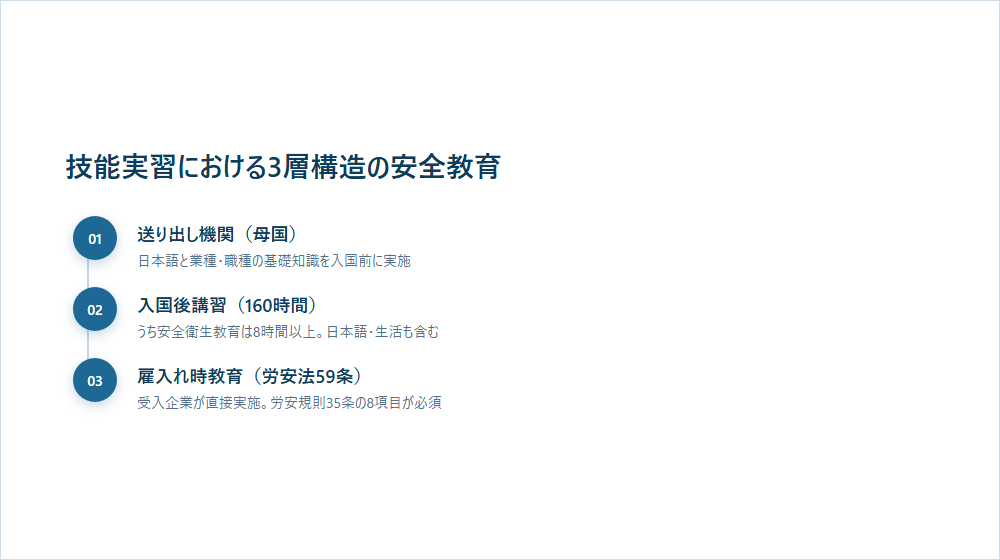
Safety and health training for technical interns is structured in 3 layers. The first is pre-arrival training by the sending organization in the home country (industry/job basics and Japanese). The second is post-arrival training of 160 hours (with 8+ hours of safety and health). The third is on-hire training by the receiving employer (Industrial Safety and Health Act Article 59 Paragraph 1 — the employer's duty to deliver safety and health training at the start of employment).
In practice, "8 hours of safety and health" was counted within the 160 hours of post-arrival training, and some receiving employers did not separately deliver on-hire training. Here is the point: the 8 hours of post-arrival training and the on-hire training under ISHA Article 59 are different things. The former is a Technical Intern Act duty; the latter is an ISHA duty. Doing both is the safest operation from a compliance standpoint.
This is, in fact, an area inspectors easily point to. We know multiple companies that received corrective guidance when "we have the post-arrival training certificate, but no on-hire training record."
A general affairs officer at a manufacturer believing "post-arrival training handled safety" was asked "where's the on-hire training record?" by an inspector and couldn't answer — this scene we've witnessed multiple times.
Safety training under Ikuseishu
How does the 3-layer structure shift under Ikuseishu? Up front: the ISHA-based obligations remain the same, while the weight and responsibility of pre/post-arrival training change significantly — that's the direction as of May 2026.
According to the interim report (released July 2025) from the joint Ministry of Justice and MHLW review, Ikuseishu is expected to secure "Japanese ability around CEFR A1" before arrival, raising the quality of pre-arrival training in the sending country by a notch. This is a tailwind for safety training: workers come to Japan after grasping basics in their native language.
On the other hand, the 160 hours of post-arrival training are likely to be shortened. This is a trade-off with the premise of "having workers acquire Japanese before arrival."
From the receiving employer's view, what remains as duties: on-hire training (ISHA Article 59) and special education (Regulations Article 36). These don't change. The correct understanding is rather: the need to raise the quality of pre-arrival training and on-hire training emerges.
Role-split before/after arrival
This section organizes how the "who teaches what, when" split differs between the two programs.
In Technical Intern, the sending organization and the supervising organization almost exclusively handled pre/post-arrival training. The receiving employer entered at the final stage as "the entity responsible for on-hire training."
Under Ikuseishu, this role-split is redesigned. The interim report shows the following direction:
- Sending organization: cover Japanese basics (A1 equivalent) and industry basics (per job) in the home country in advance
- Supervising-support organization (successor to the Technical Intern supervising organization): focus on post-arrival life support and record management
- Receiving employer: directly handle on-hire training, special education, and site-specific safety training after employment starts
Here is the point: the design increases the weight of what the receiving employer directly handles. The previous operation of "leaving things to the supervising organization" becomes less viable under Ikuseishu.
Frankly, many executives have not yet grasped this point.
Supervising organization vs. supervising-support organization
This section compares the roles of "supervising organization (Technical Intern)" and "supervising-support organization (Ikuseishu)" specifically for safety training.
Under the Technical Intern Act, the supervising organization's core business is "guidance to the implementing entity (receiving employer)" — the receiving employer was responsible for delivering safety training itself. However, post-arrival training was conducted directly by the supervising organization.
Under the Ikuseishu Act (provisional name), the supervising-support organization is designed to focus more on "protection and career development support of Ikuseishu foreign workers." The function of directly delivering safety training is expected to shrink relatively.
Frankly, this is a structural change that makes it easier to get cornered after 2027 for receiving employers who don't have an in-house safety training system.
Impact on receiving employers' operations
This section organizes how operations at receiving employers change after Ikuseishu starts, broken down into concrete preparation items.
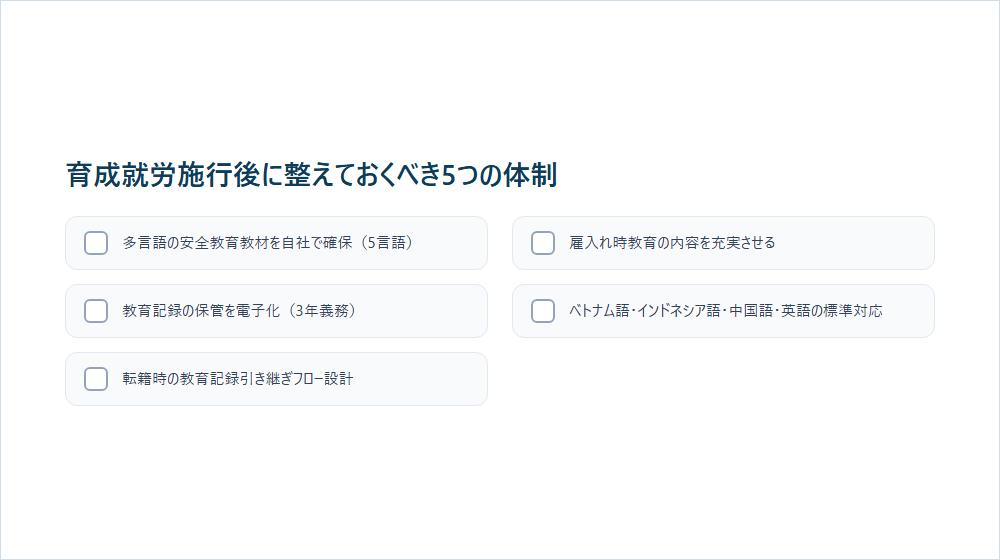
- Secure materials in-house: instead of materials via the supervising organization, receiving employers need to secure multilingual safety training materials in-house.
- Review on-hire training: with post-arrival training likely shortened, on-hire training content needs to be enriched.
- Digitize record retention: as the share directly delivered by the receiving employer increases, the cost of managing training records rises. Digital is the realistic answer (→ Retention period and format of on-hire training records).
- Prepare for 5-language support: in anticipation of diversification of sending countries, preparing standard support for Vietnamese, Indonesian, Chinese, and English gives peace of mind.
- Transfer handover flow: as Ikuseishu enables transfer, an operation for handing over training records at transfer is needed.
Training handover at transfer
This section organizes the practical issue of the biggest program change in Ikuseishu — "transfer" — from a safety training perspective.
In Technical Intern, transfer was in principle not possible. Under Ikuseishu, transfer is possible under certain conditions for the worker's intent or operational inconvenience. This is the right direction for worker rights protection, but from the safety training handover view, on-hire training is needed again at the transfer destination.
ISHA Article 59 Paragraph 1 says "when an employer hires a worker"; since the hiring entity (employer) changes, the duty to deliver on-hire training at the new employer arises. The scope for omission based on "having prior experience in the same industry" (Regulations Article 35 Paragraph 2) applies, but items outside that scope (site-specific hazards, equipment, work procedures) must be delivered.
Here is the point: the worker does not carry the previous workplace's training record with them. There is currently no mechanism for receiving employers to share records, and the realistic operation at the transfer destination is "structure on-hire training from zero."
Three traps in the transition period
This section lists 3 traps receiving employers tend to fall into around April 2027.
- "Technical interns" and "Ikuseishu workers" coexist on site: under transitional measures, technical interns from before implementation are treated as technical interns until the end of residency. Running two programs in parallel is necessary; not mixing up training records and operating rules matters.
- Misreading "shortened post-arrival training" as "reduced safety training": post-arrival training will likely be shortened, but this is to "shift Japanese ability to before arrival," not to reduce the amount of safety and health training. On-hire training quality must rise instead.
- Treating transfer purely as "career opportunity" and neglecting training handover: the transfer-enabling system is important for worker protection, but from the safety training view, "re-delivering on-hire training at each transfer" is needed. The receiving employer's operational load will rise reliably.
Frankly, those officers who have read this far are already half a step ahead of their peers. This area still has low information transparency; companies that arrange their systems early will move through the transition more smoothly.
Labona's coverage
Summary
Comparing Technical Intern and Ikuseishu through the lens of safety training: the ISHA-based obligations don't change, while pre/post-arrival role-split and transfer operations shift significantly — that's this article's conclusion.
What to prepare by April 2027: (1) secure multilingual training materials in-house, (2) enrich the on-hire training content, (3) digitize record retention, (4) prepare for 5-language support, (5) design the transfer handover flow. These five greatly influence operational load after Ikuseishu starts.
The smartest move is to bake into your system, now, the structural shift from "things move if we leave it to the supervising organization" to "the receiving employer directly handles."
→ Try Labona's safety e-learning
FAQ
Q. How will technical interns be treated after April 2027?
Under transitional measures, those who came in as technical interns before implementation remain as technical interns until the end of residency. Receiving employers continue Technical Intern Act obligations (operation through supervising organization), and new intake uses the Ikuseishu program — a dual operation that continues for some time.
Q. Does the on-hire training burden increase when post-arrival training is shortened?
The design direction is "thicken Japanese and industry basics before arrival; shorten post-arrival training." The number of on-hire training items (ISHA Article 59) doesn't change in itself, but with the premise that learners' Japanese comprehension rises, more substantive content may be expected.
Q. When an Ikuseishu worker transfers, can the previous training records be used?
Under Industrial Safety and Health Regulations Article 35 Paragraph 2, items for which sufficient knowledge and skill are recognized can be omitted. However, items unique to that workplace — site-specific hazards, equipment, work procedures — cannot be omitted. In practice, structuring on-hire training from zero at the transfer destination is the safe premise.
Q. To what extent is 5-language support necessary?
Sending country composition shifts, but currently Vietnam, Indonesia, China, the Philippines, and Myanmar are in the top group. Many companies set Vietnamese, Indonesian, Simplified Chinese, English, and Japanese as the 5-language standard.
Q. Are the Ikuseishu organization and the current supervising organization separate?
The supervising-support organization is designed for current supervising organizations to continue by re-obtaining authorization, inheriting the function. The organization carries continuity, but the role's center of gravity shifts from "supervision" to "development support."