
ⓘ Key points
- Logistics ranks high in foreign-worker accidents as the transport sector. Centered on warehouse caught-in/between, falls, and slips/trips
- On-hire safety and health training (ISHA Article 59 Paragraph 1) is mandatory across all industries. Layer warehouse-specific items on top
- Forklift and slinging are separate special education. Assigning work without certificates is illegal
- Multilingual priority is high for Vietnamese, Chinese, and Indonesian
- Without documented role split with supervising organizations and dispatch agencies, training records easily go blank
"We hired Vietnamese workers, but we don't know where to start warehouse safety training." We get this request increasingly from logistics safety officers. Accidents differ in type between delivery drivers and warehouse staff, and standard on-hire training templates alone are not enough. This article gives logistics safety officers at companies employing foreign workers a training design procedure usable on site as-is.
Who this guide is for: Operations and HR managers at Japan-based logistics companies (warehousing, last-mile delivery, 3PL) employing foreign workers in Japan. This guide explains the Japanese Industrial Safety and Health Act and the Japan-specific operational reality — not US/EU logistics safety frameworks.
Why foreign-worker employment is growing in logistics in Japan
EC demand surge plus domestic labor shortage in Japan have pushed up the foreign-worker ratio in Japanese warehouses and delivery sites.
In recent years, with the expansion of Amazon, Rakuten, and major 3PLs, demand for warehouse staff has surged. The MHLW "Notification status of foreign worker employment" shows that the number of foreign workers in transport and postal services trends upward every year, and the composition share is becoming notable.
What's happening on logistics sites comes down to three things:
- Warehouse operator shortage: technical interns and Specified Skilled Workers are increasingly assigned to picking, packing, and sorting
- Last-mile delivery worker shortage: foreign drivers are increasing in small-cargo and parcel delivery
- Larger 3PL bases: single bases of 500+ people are increasing, and multi-national team operation is becoming standard
Frankly, on-site safety training has not caught up with this speed. Sites that ran on senior Japanese workers' verbal instruction suddenly become 5-country mixed teams. Cases where companies notice "no training records" only after an accident happens stand out.
Logistics has a structure where safety training is easily back-burnered because "as an industry, accident data is less prominent than manufacturing." The lower accident rate is partly supported by simple work content rather than quality of safety management, and that premise collapses the moment foreign-worker ratios rise.
→ Request Labona's safety e-learning materials
5 common accident patterns in warehouses
Warehouse accidents are a hybrid of "machine accidents in manufacturing" and "falls/slips in construction." To prioritize training, anchor the patterns first.
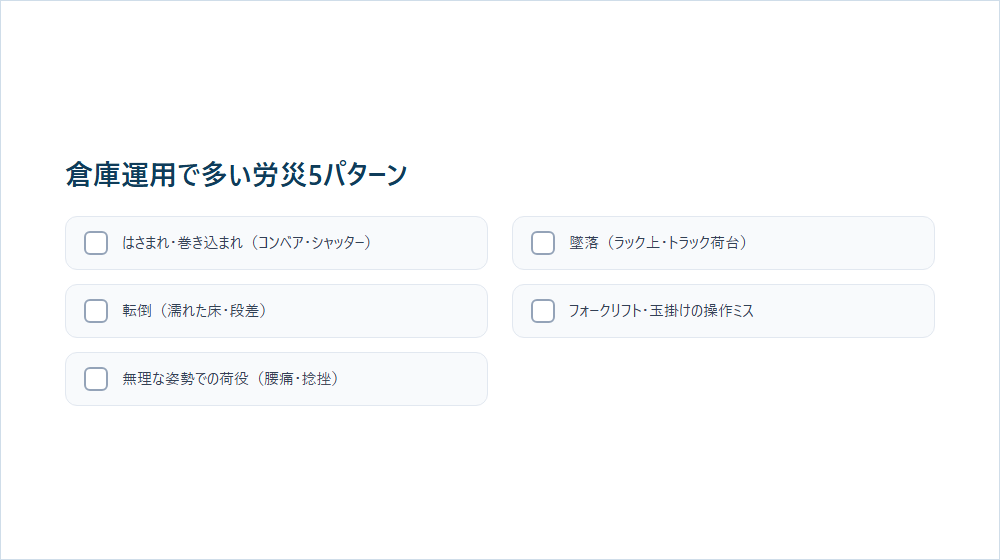
① Caught in / between
Conveyors, shutters, stacker cranes in automated warehouses — warehouses have more moving parts than imagined. The accident where a glove gets pulled into a conveyor when clearing a jam happens at the same frequency as in manufacturing.
② Falls from height
Falls from high racks, truck beds, and tailgates (lift gates) happen frequently. Work at 2m+ requires full-harness fall arrest equipment, subject to special education.
③ Slips / trips
Warehouse floors are slipperier than expected. Condensation in cold storage, intake areas in rain, oil stains on cardboard cause this. In Rikusaibou (Land Transport Accident Prevention Association) statistics too, slips/trips are always at the top of transport accidents.
④ Forklift / slinging operation errors
Solo forklift accidents and load collapse during slinging surge in workers with completion certificates but unfamiliar with the equipment. Without native-language re-training, the accident rate doesn't drop.
⑤ Awkward postures during cargo handling
Back pain and sprains are easily dismissed as accidents, but in logistics they're at the top of accidents requiring 4+ days off. Training on heavy-load handling (MHLW guidelines) is needed.
ⓘ Characteristics of warehouse accidents
Unlike manufacturing where "if the machine is stopped, it's safe," warehouses have "people, things, and forklifts all moving on the same floor." Both flow design and training are needed; training alone has limits.
Logistics-specific items in on-hire training
When you hire warehouse staff, deliver on-hire safety and health training (ISHA Article 59 Paragraph 1) before assignment. The April 2024 law revision removed industry restrictions; logistics also requires this for all workers.
The 8 items in Industrial Safety and Health Regulations Article 35 are the standard; for logistics, always layer work-specific additions.
Logistics-specific items to add to the standard 8
- In-warehouse flow and forklift driving rules: separation of pedestrian and driving lanes, crossing rules, refuge zones
- High work procedures for racking / inventory check: prohibition of climbing racks, use of picking carts, full-harness wearing criteria
- Heavy load handling: per-person upper weight limit (MHLW guideline: 40% of body weight for men as a benchmark), two-person carry criteria, use of aids
- Special risks of cold / freezer warehouses: frostbite, reduced concentration in low temp, slips/trips due to condensation
- Shutter / dock leveler safety: caught when opening/closing, prevention of truck unintended departure
Retaining training records
The on-hire training record carries a 3-year retention obligation (Industrial Safety and Health Regulations Article 38). For technical interns, reporting via supervising organization to OTIT is also needed, so digital retention is realistic.
- Learner name, date of birth, residency status
- Date/time of delivery, language used, instructor name
- Curriculum, comprehension test results
- Completion sign-off (learner and training officer)
⚠️ Penalties and civil liability
If an accident happens without on-hire training delivered, both criminal liability (ISHA violation) and civil liability (breach of the duty of care for safety = the company failed in its duty to protect workers from danger) arise. Damages not covered by workers' accident insurance fall directly on the company.
Delivery work safety training (accidents while driving)
Accident types differ greatly between warehouse staff and delivery drivers. Drivers need training design centered on road accidents.
Driver-specific risks
- Reverse-driving accidents: tight parking at delivery locations, turn-arounds in residential areas
- Load collapse: sudden braking / cornering causing load shift, insufficient lashing
- Falls from cargo bed: truck beds, during tailgate ascent/descent
- Long-driving fatigue: drowsy driving, reduced judgment
- Pedestrian / bicycle contact: frequent in residential-area parcel delivery
Confirming international and domestic licenses
What's easily overlooked when hiring foreign drivers is licenses.
- Conversion to Japanese license: conversion from home-country license to Japanese license is mandatory (international permits cannot be used for business operation)
- Aptitude test: confirmation of vision, hearing, reaction speed
- Vehicle category check: mid-size, large, towing, etc. restrictions
Pre-delivery driver training
Beyond on-hire training, before assigning delivery work, safety driving training as a truck driver is desirable. Following Rikusaibou (Land Transport Accident Prevention Association) guidelines, build it tailored to your routes and vehicles.
Forklift and slinging are separate
The most common accident source when employing foreign workers in logistics. Separate special education or skills training from on-hire training is needed; don't confuse them.
Forklift
- Max load under 1 ton: special education (ISHA Article 59 Paragraph 3 — duty to deliver specialized training before assigning hazardous work)
- Max load 1 ton or more: skills training (ISHA Article 76 — skills training required for certain hazardous work)
Skills training is delivered at registered training organizations, issuing completion certificates. Assigning work without a certificate carries imprisonment up to 6 months or fines up to 500,000 yen (ISHA Article 119 — penalty for violation of training duty).
Slinging
- Lifting capacity under 1 ton: special education
- Lifting capacity 1 ton or more: skills training
Sites that use overhead cranes in warehouses require slinging completion certificates. Needed for unpacking import containers, bringing in large machinery.
Full-harness fall arrest equipment
Work at 2m+ heights (on racks, tarp work on truck beds, etc.) requires full-harness fall arrest equipment special education. The waist-belt type causes internal injuries on falls and as a rule is not used.
⚠️ Verifying authenticity of certificates
A "forklift license" obtained overseas has no effect under Japanese law. They must obtain the completion certificate again at a domestic registered training organization. Since technical interns often take training via supervising organization, verify the original of the completion certificate at hiring.
For logistics special education, see our separate Complete Guide to Multilingual Special Education for the overall picture.
Multilingual priority
The foreign-worker ratio in logistics varies by sector, and spreading resources equally across all languages inflates training costs. Decide priority from the data.
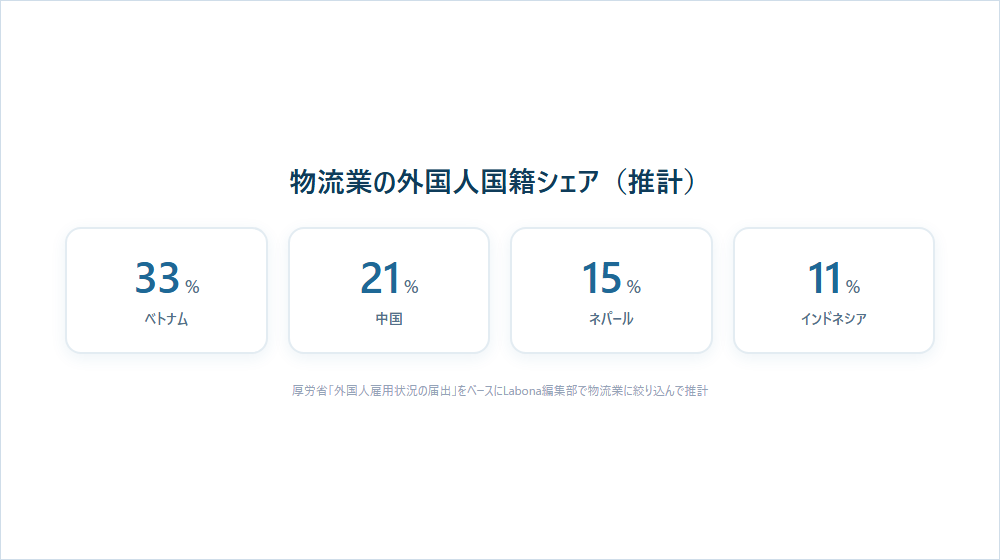
Estimated share and material investment policy
Foreign workers in logistics, on MHLW notification basis, are dominated by Vietnam, China, Nepal, Indonesia at the top. Material investment priority is rational in this order.
- Vietnamese: first priority. Main sending country for technical interns
- Chinese (Simplified): second priority. Steady on Specified Skilled Worker and Engineer/Specialist visas
- Indonesian: third priority. Specified Skilled Worker growth is significant
- English: as common language for Nepali, Filipino, and South Asian workers
- Plain Japanese: safety net for everyone
Dedicated Nepali materials have low cost-effectiveness, so covering with English version + plain Japanese is practical.
Align subtitle / dubbing / test question languages
A common failure is "video in Japanese only, subtitles only multilingual." Workers below N3 can't follow subtitles, and comprehension drops significantly.
- Dub video audio in the native language (or build native-language video from the start)
- Run comprehension tests in the native language, with pass threshold 80%+
- On failure, mandate re-attendance
- Align material and test languages (avoid mixing video in Japanese with tests in Vietnamese, etc.)
Unify technical term translations
For terms like "slinging," "lockout," "full-harness" — build a glossary so terms don't drift across languages. Different translations across supervising organizations confuse workers at job change.
Role split with supervising organizations and dispatch agencies
Logistics has a high ratio of technical interns and dispatch workers, making the responsibility boundary for safety training easily ambiguous. Disputes over "that wasn't our training scope" after an accident are not rare.
For technical interns
The supervising organization teaches Japanese labor law, basic Japanese, and elementary safety and health in post-arrival training. However, this is not a substitute for on-hire training. The implementing entity (receiving employer) needs to deliver on-hire training again before assignment.
- Supervising organization: post-arrival training (not on-hire training under ISHA)
- Implementing entity: on-hire training, special education, on-site OJT, near-miss training
- Conclude the role split in writing and have both sides keep copies
For dispatch workers
The duty to deliver on-hire training for dispatch workers lies with the dispatch agency employer (Worker Dispatch Act Article 45 → application of ISHA Article 59). However, special education for site-specific work procedures and equipment is the responsibility of the user company (receiving employer).
- Dispatch agency: general on-hire training (8 items of Industrial Safety and Health Regulations Article 35)
- User company: site-specific work procedures, special education, site-specific risk training
- Pre-coordinate training content between dispatch agency and user company to prevent duplication and gaps
ⓘ Recommendation to document
Put role splits with supervising organizations and dispatch agencies into memorandums or contracts rather than verbal. The responsibility boundary at accident becomes clear, and explanation to the labor inspector goes smoothly.
Labona's coverage
Summary
Foreign-worker safety training in logistics is structured on the premise that accident types differ between warehouse and delivery. Organize warehouse around forklift, falls, slips/trips, and caught-in/between; organize delivery around reverse accidents, load collapse, and long driving.
For on-hire training, layer logistics-specific items (flow, cold warehouse, heavy loads) on top of the standard 8 items; manage special education (forklift, slinging, full-harness) separately. For multilingual, prioritize the 3 languages of Vietnamese, Chinese, and Indonesian. Conclude the role split with supervising organizations and dispatch agencies in writing. With these 4 in place, logistics' duty of care for safety is largely satisfied.
Rather than panicking after an accident, arranging the training system before the foreign-worker ratio rises is, in the end, the lowest-cost option.
FAQ
Q1. Should we separate on-hire training for warehouse staff and delivery drivers?
Separating the curriculum is practical. The 8-item frame is common, but for warehouse staff, layer in flow / forklift driving / cold warehouse; for delivery drivers, layer in reverse accidents / load collapse / long driving. If the same company has both, deliver separate curricula before assignment.
Q2. With technical interns' post-arrival training, can on-hire training be omitted?
No. Post-arrival training is overview education on Japanese language and labor law delivered by the supervising organization — different from the on-hire training defined by ISHA Article 59. The implementing entity (receiving employer) must separately deliver on-hire training before assignment. Labor inspector spot checks verify both records.
Q3. Can someone with a forklift license from their home country drive in Japan as is?
No. Completion certificates from overseas have no effect under Japan's Industrial Safety and Health Act, so they must take skills training or special education again at a domestic registered training organization. Letting them drive without a certificate can carry imprisonment up to 6 months or fines up to 500,000 yen for the company.
Q4. For dispatch workers, who delivers safety training, the dispatch agency or user company?
General on-hire training (8 items of Industrial Safety and Health Regulations Article 35) is the dispatch agency's duty. However, site-specific risks / work procedures / special education at the user company is the user company's responsibility. Pre-coordinate training content between both sides and conclude a memorandum to prevent duplication and gaps.
Related articles
- Complete Guide to Safety and Health Training for Foreign Workers
- Safety Training Checklist for Foreign Workers in Manufacturing
- Safety Training for Foreign Workers in Construction
- Complete Guide to Multilingual Special Education
Primary references
- Industrial Safety and Health Act Article 59 (Safety and health training) — search on e-Gov law search
- Industrial Safety and Health Regulations Articles 35, 38 — search on e-Gov law search
- Worker Dispatch Act Article 45 (Dispatch agency's safety and health training duty) — search on e-Gov law search
- MHLW "Notification status of foreign worker employment" — search the latest on MHLW website
- MHLW "Status of occupational accidents to foreign workers" — search the latest on MHLW website
- Land Transport Accident Prevention Association related materials — association website
- MHLW "Guidelines for preventing back pain in the workplace" — search on MHLW website